
Blog
Does Life Insurance Count Toward Your Oklahoma Buy-Sell Agreement Valuation?
The Supreme Court's Connelly decision changed how company-owned life insurance factors into a buy-sell agreement valuation. Here's what Oklahoma business owners need to document before the IRS, or a surviving partner, asks the question for them.
A buy-sell agreement is supposed to settle, in advance, what happens to a business interest when an owner dies. For decades, many Oklahoma closely held companies assumed that company-owned life insurance used to fund the buyout simply disappeared from the valuation math: the policy paid out, the company bought back the shares, and the books balanced. The Supreme Court's 2024 decision in Connelly v. United States said otherwise, and it changed how a redemption-funded buy-sell agreement has to be valued for federal estate tax purposes.
If your company's succession plan rests on a business valuation tied to a redemption agreement and company-owned insurance, this ruling is worth understanding before the next ownership transition, not after.
What Connelly v. United States Actually Decided
Two brothers owned a closely held corporation together and had a redemption-style buy-sell agreement: when one died, the company would use life insurance proceeds to buy back his shares from his estate. The company received $3 million in insurance proceeds, used part of it to redeem the deceased brother's interest, and reported a lower estate tax value that treated the redemption obligation as an offsetting liability.
The IRS disagreed, and in a unanimous ruling the Supreme Court agreed with the IRS. The Court held that life insurance proceeds received by a corporation are a corporate asset that increases the company's value, and the redemption obligation does not automatically cancel that increase dollar for dollar. The opinion is available directly from the Supreme Court, and the case page is also indexed through Cornell's Legal Information Institute.
In plain terms: the brothers' agreement treated the insurance as a wash. The Court treated it as cash sitting on the balance sheet, available to any buyer, right up until the moment it was spent on the redemption.
The Hypothetical Willing Buyer: Why the Redemption Obligation Didn't Reduce Value
Federal estate tax valuation asks what a hypothetical willing buyer would pay a hypothetical willing seller for the whole company, neither one under compulsion. That standard is the heart of why Connelly came out the way it did.
A buyer purchasing the entire company would receive the $3 million in insurance proceeds along with everything else the business owns. That buyer would have no obligation to redeem the deceased owner's shares, because the redemption only existed as a contract between the two original brothers and the company; a new owner of the whole enterprise simply steps into a business that holds extra cash. The Court reasoned that an obligation only one specific set of parties owes each other isn't the kind of liability that reduces what a hypothetical buyer of the whole company would pay.
That is the mechanism worth sitting with: the redemption promise was real between the two brothers, but it was not a liability from the perspective of someone buying the whole business. Several estate planning commentators have walked through this reasoning in detail, including the analysis published in the NAEPC Journal, which lays out options advisors are now recommending to prevent the same outcome.
One additional fact worked against the brothers: their agreement contained a valuation mechanism they were supposed to follow annually, and they never actually used it. When a company's own paperwork shows an agreed procedure for setting value and the owners ignored it, a court has less reason to defer to whatever number the owners later claim. That detail matters as much as the insurance issue itself, and it comes back later in this guide.
Redemption, Cross-Purchase, and Hybrid Agreements: Who Connelly Actually Hits
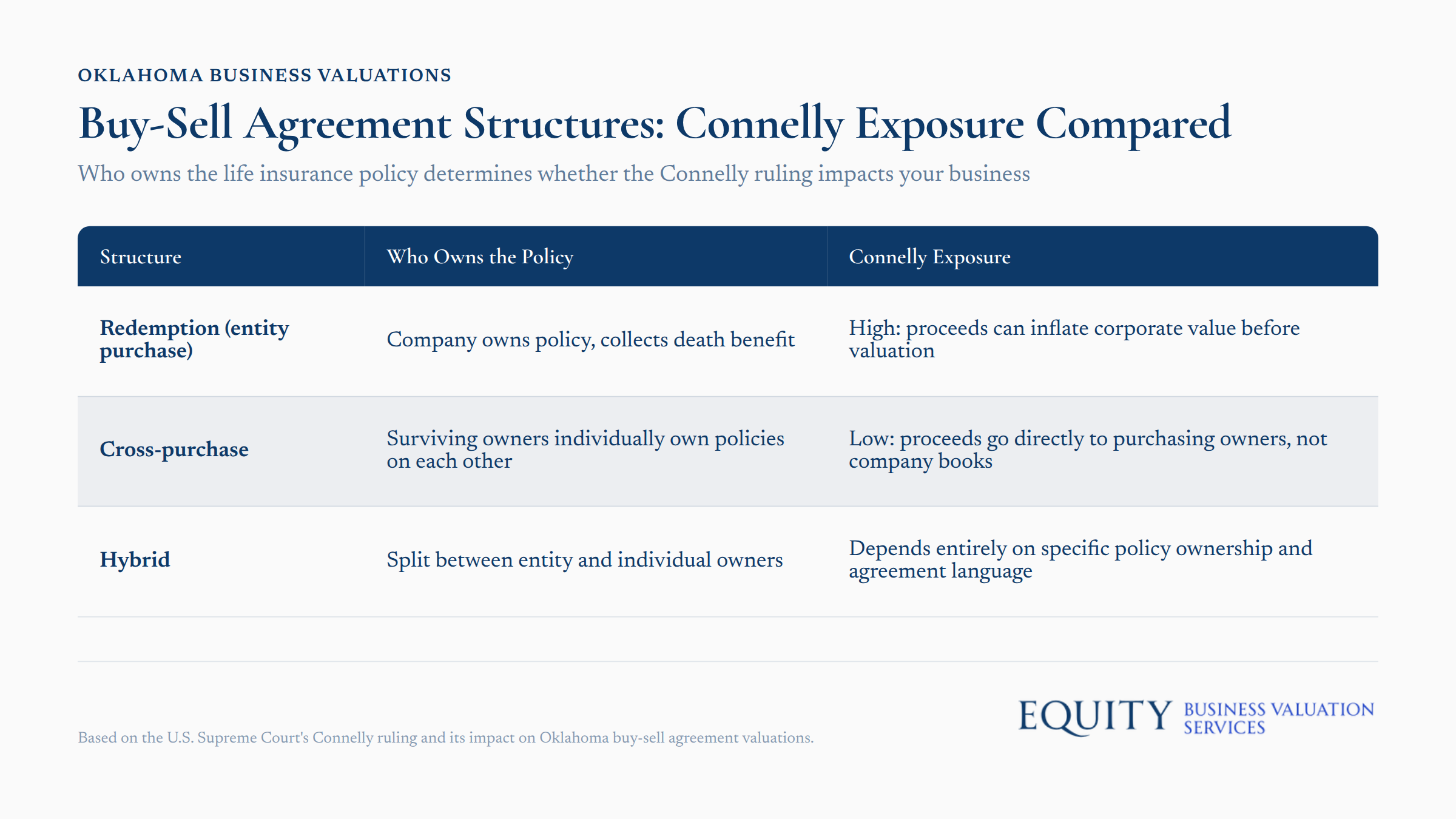
Key takeaway: Connelly's exposure is concentrated almost entirely in redemption agreements funded by company-owned life insurance. Cross-purchase agreements, where co-owners carry policies on each other individually, generally route proceeds straight to the purchasing owners rather than onto the company's balance sheet.
The structure of your buy-sell agreement determines whether this ruling touches your business at all.
| Structure | Who owns the policy | Connelly exposure |
|---|---|---|
| Redemption (entity purchase) | The company owns the policy and collects the death benefit | High: proceeds can increase corporate value before the deceased owner's interest is valued |
| Cross-purchase | Surviving owners individually own policies on each other | Low: proceeds generally go directly to the purchasing owners, not onto the company's books |
| Hybrid | Ownership and purchase rights are split between the entity and individual owners | Depends entirely on the specific policy ownership and agreement language |
Most small and mid-size Oklahoma companies with more than one owner use a redemption agreement because it is administratively simpler: the company carries one policy per owner instead of each owner carrying policies on every partner. That administrative convenience is exactly what creates the Connelly exposure. A hybrid agreement needs the same scrutiny, since the entity-owned portion of the structure can carry the same risk even if some proceeds flow to individual owners directly.
The Federal Estate Tax Exemption Narrows, but Doesn't Eliminate, the Risk in Oklahoma
Key takeaway: Connelly matters most to businesses whose total value, including any insurance-driven bump, approaches or exceeds the federal estate tax exemption. For 2026, that threshold rises substantially, which shrinks the number of Oklahoma companies directly exposed, but it does not make the issue disappear for growing or larger businesses.
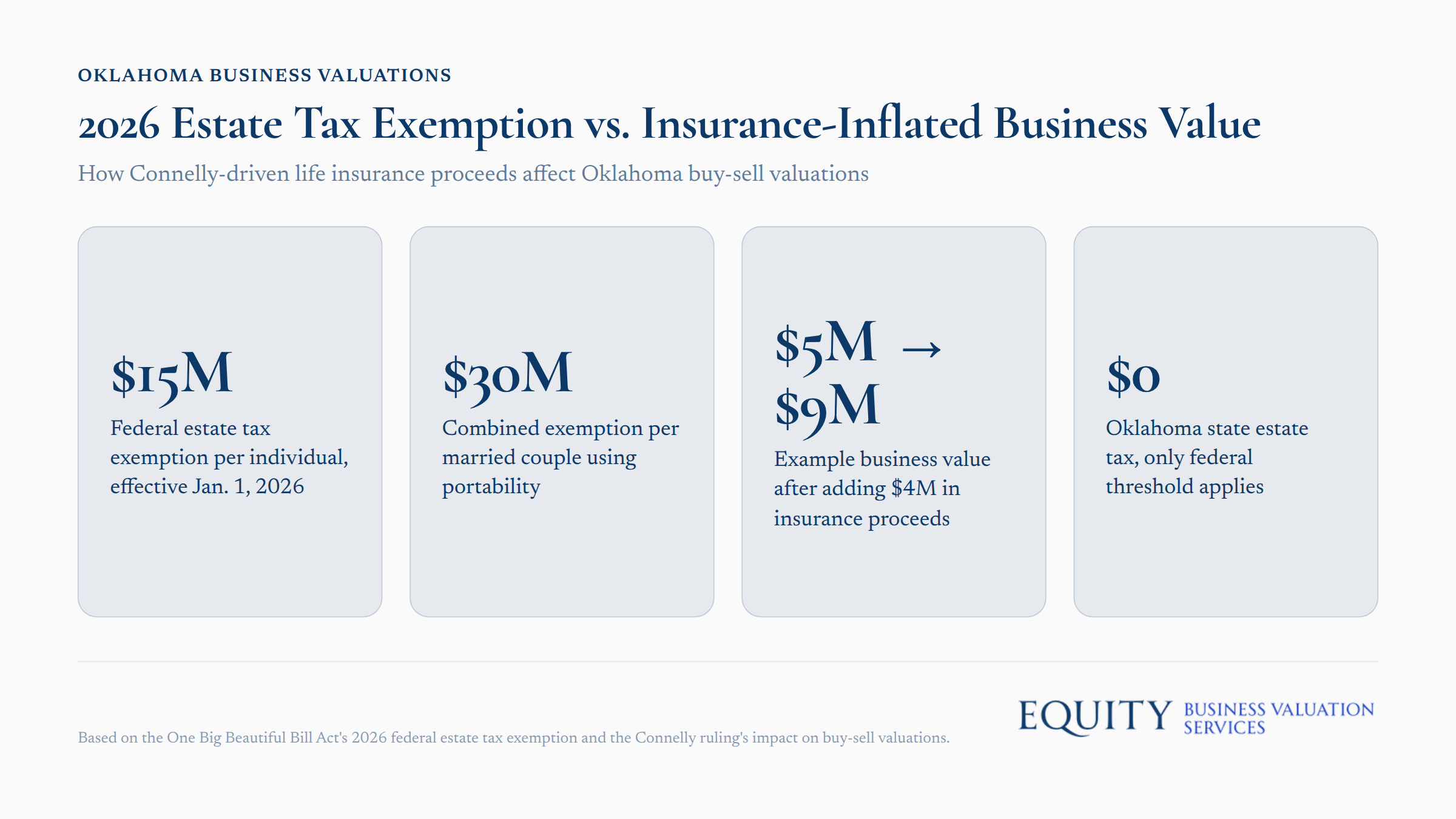
Under the One Big Beautiful Bill Act, the federal estate tax exemption is set at $15 million per individual, or $30 million per married couple using portability, effective January 1, 2026. Oklahoma has no separate state estate tax, so Oklahoma business owners measure their exposure against this single federal number rather than a state threshold as well.
For a company well under that combined threshold, a Connelly-driven increase in value from insurance proceeds may never trigger an actual estate tax bill. But the math still matters for two groups: businesses already approaching the exemption level through other assets, and businesses where the insurance proceeds themselves are large enough to push an otherwise modest estate over the line. A $5 million business that collects $4 million in company-owned life insurance at an owner's death is no longer a $5 million business for valuation purposes; it may be closer to $9 million before any redemption is even considered.
What an Independent Valuation Should Document in Your Agreement
The practical fix is not a legal argument about who was right in Connelly. It's a valuation that makes the treatment of insurance explicit, before anyone has to defend it to the IRS or to a surviving partner.
An independent business valuation prepared for a buy-sell agreement should clearly document:
- Whether insurance proceeds are folded into or carved out of the purchase price, stated in language the agreement itself can point to
- The valuation date and method used for the business apart from any policy, so the enterprise value and the insurance value are never blended by accident
- How cash surrender value is treated before death, separate from how death proceeds are treated after a policy pays out
- The redemption obligation's actual effect on value, addressed directly rather than assumed to be an automatic offset
Our business valuation team approaches buy-sell engagements as the independent, defensible number that both the agreement and, if it ever comes to it, a tax authority can rely on. Fees for this kind of engagement are quoted as a fixed amount after we scope the assignment, consistent with our published business valuation pricing, and reflect the complexity of the ownership structure and the depth of analysis the agreement requires, not the dollar value of the business itself.
If your company's buy-sell agreement also intersects with estate and gift tax planning, our guide to Oklahoma estate and gift tax rules for business owners covers the broader filing requirements that a Connelly-exposed valuation often feeds into.
Follow Your Own Valuation Procedure, Every Year, in Writing
The Connelly brothers had an agreed mechanism for setting value and never used it. That detail is easy to overlook next to the headline insurance issue, but it is just as instructive for Oklahoma owners.
An agreement that promises an annual appraisal, a periodic formula update, or a scheduled valuation only protects a business if the company actually follows it and keeps dated records showing that it did. A buy-sell agreement with a valuation mechanism nobody ever used looks, to the IRS, like a number the owners picked for convenience rather than one set by an arm's-length process. The IRS has also published guidance on valuing life insurance contracts themselves for specified federal tax purposes, available in Revenue Procedure 2005-25, which underscores how closely the agency scrutinizes the mechanics behind these numbers.
For Oklahoma estates generally, state law already requires certain insurance-related items to be accounted for within the gross estate framework under Oklahoma's estate tax statute, even though Oklahoma itself no longer imposes a standalone estate tax. That statute is a reminder that insurance and valuation intersect in more than one place in the law, not just at the federal level.
Industry commentary written for business owners navigating this exact transition, including analysis from Fifth Third's wealth planning team, consistently lands on the same recommendation: pair a current, independent valuation with a legal review of how the agreement's language handles insurance, rather than treating the two as separate exercises.
Review the Agreement and the Policy Together
Connelly didn't invalidate buy-sell agreements or make company-owned life insurance a bad funding choice. It clarified that the two have to be reconciled on paper, with a valuation that says plainly how insurance is treated, updated on the schedule the agreement actually promises.
Our team prepares the independent valuation piece of that review: a defensible, dated number that distinguishes enterprise value from policy value and documents the method behind both. We don't provide legal advice on how to draft or amend the agreement itself; that part belongs with your attorney, working from the valuation rather than guessing at it. Request an appraisal to get your buy-sell agreement's valuation reviewed before the next ownership transition forces the question.
This article is provided for general informational purposes only and does not constitute legal, tax, or financial advice. Readers should consult a qualified attorney or CPA regarding their specific circumstances.