
Blog
How Add-Backs and Normalized Earnings Reshape an Oklahoma Business's True Value
Add-backs adjust a small business's reported earnings to reflect what a new owner would actually take home, and getting them wrong can swing a valuation by hundreds of thousands of dollars. This guide explains which adjustments hold up under scrutiny and which ones invite a buyer or the IRS to challenge your number.
Every small business owner in Oklahoma runs the business a little differently than a textbook would suggest. A rancher pays a nephew in cash for calving season. A construction contractor puts a truck payment through the company that his wife also drives. An oilfield services owner absorbs a lawsuit settlement in one bad year that will never happen again. None of that is wrong, and none of it is unusual. But when it comes time to value the business, for a sale, a divorce, an estate, or a loan application, those choices have to be unwound so the numbers reflect what the business actually earns.
That unwinding process is called normalization, and the individual adjustments that drive it are called add-backs. Get them right and a valuation holds up under review. Get them wrong, unsupported, or inflated, and the conclusion collapses the moment a buyer's lender, a judge, or the IRS asks for documentation. Our Oklahoma business valuation team builds add-back schedules the same way every time: with a specific dollar figure, a specific reason, and a specific piece of paper behind it.
What Is an Add-Back and Why Normalization Drives Value
An add-back is an adjustment made to a company's reported earnings to remove an expense (or add back income) that does not reflect the ongoing, arm's-length operation of the business. The result is called normalized earnings: what the business would earn under normal market conditions, run by a typical owner or manager, without the quirks of the current owner's personal choices.
Normalization matters because most small business valuations are built on a multiple of earnings. If reported earnings are $150,000 but the true, normalized earnings are $280,000, and the applicable multiple is 3.0, that difference in the earnings base alone changes the concluded value by $390,000. The multiple didn't move. The earnings number did, because the add-backs corrected what the tax return alone doesn't show.
Professional valuation standards recognize this explicitly. Appraisers working under the credentialing frameworks of the American Society of Appraisers and the National Association of Certified Valuators and Analysts define normalized financial statements as those adjusted for non-operating items, non-recurring items, and discretionary items so that the resulting earnings stream is comparable across time periods and comparable to other businesses in the market. USPAP's development standards require that the appraiser identify and support the assumptions underlying any such adjustment, not simply assert it. That standard is what separates a defensible add-back from a number someone made up to make the business look better.
Owner Compensation Adjustments: SDE vs EBITDA
The most consequential add-back in almost every Oklahoma small business valuation is owner compensation. Because the owner's salary, bonuses, benefits, and personal perks are all discretionary decisions made by the person who also controls the checkbook, the reported compensation figure rarely reflects what an unrelated manager would need to be paid to run the business day to day.
This is where the distinction between seller's discretionary earnings (SDE) and EBITDA becomes important, and the two get confused constantly.
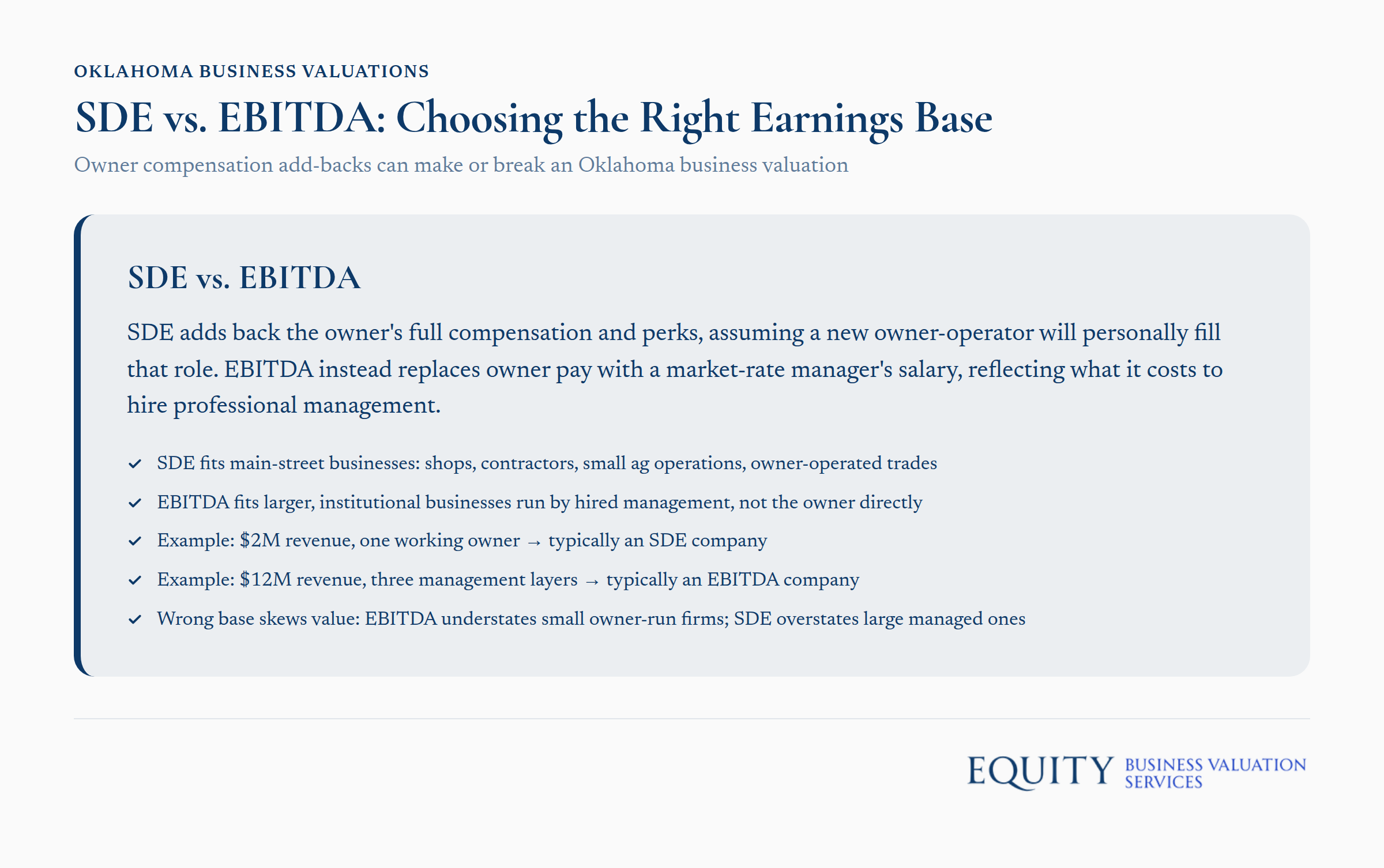
- SDE adds back the full owner's compensation and owner-related perks to earnings, on the theory that a single owner-operator buying the business will personally fill that role and take home the full benefit stream. SDE is the standard earnings base for most main-street Oklahoma businesses: single-location shops, service contractors, small agricultural operations, and owner-operated trade businesses.
- EBITDA (earnings before interest, taxes, depreciation, and amortization) replaces the owner's actual compensation with a market-rate replacement salary, what it would cost to hire a professional manager to run the operation. EBITDA is the more appropriate earnings base for larger, more institutional businesses, or any business a financial buyer would run with hired management rather than working in it personally.
Choosing the wrong base is one of the most common valuation errors we see. A business with $2 million in revenue and a single working owner is almost always an SDE company. A business with $12 million in revenue and three layers of management under the owner is almost always an EBITDA company. Using EBITDA on the small owner-operated business understates value, because it strips out the full benefit an owner-buyer would actually receive. Using SDE on the larger management-dependent company overstates value, because no institutional buyer would run it as a one-person show.
One-Time and Non-Recurring Expenses in Oklahoma's Weather and Energy Cycles
Oklahoma businesses absorb a particular set of one-time shocks tied to the state's weather patterns and its energy-driven economy, and these belong back in earnings because they are not expected to recur every year. Common examples include:
- Storm and hail damage repairs. A roofing or equipment repair triggered by an ice storm or a tornado season is a real cost, but it is not a normal annual operating expense.
- Litigation settlements and legal fees. A one-time lawsuit, whether the business won, lost, or settled, distorts a single year's earnings without telling a buyer anything about ongoing profitability.
- Equipment breakdowns and major unscheduled repairs. A cracked engine block on a drilling rig or a compressor failure at a processing plant can produce a repair bill many times the size of routine maintenance.
- Energy-cycle downturns and spikes. A year with an unusually large loss tied to a commodity price collapse, or an unusually large gain tied to a price spike, may need separate discussion even when it isn't removed outright, because a single anomalous year can distort a multi-year earnings trend.
The test for whether an expense qualifies as non-recurring is not whether it happened once. It's whether a reasonably informed buyer would expect it to happen again under normal operating conditions. A business that has a fire loss every three years does not get to add back "one-time" fire losses; that is simply a recurring cost of doing business in that facility. A business that had one hailstorm claim in fifteen years of operating records has a legitimate case.
Discretionary and Personal Expenses Run Through the Business
Beyond compensation, owner-operated Oklahoma businesses commonly run a range of personal expenses through the company books, particularly in trades, agriculture, and family-run construction and energy service businesses. Typical items include:
- Personal vehicles. A truck used partly for hauling equipment and partly for personal errands, with the full lease or depreciation expensed to the business.
- Family member payroll. Wages paid to a spouse, adult child, or other relative for work that is minimal, seasonal, or not at fair market rates for the role.
- Travel and entertainment. Hunting leases, trade show trips that double as vacations, or country club dues booked as a business development expense.
- Personal insurance and benefits. Life insurance premiums on the owner, or health coverage extended to family members who don't otherwise work in the business.
Each of these can be a legitimate add-back, but only to the extent it exceeds what the business would actually need to pay for that function on an arm's-length basis. If family payroll of $60,000 a year covers work that a market-rate part-time bookkeeper would perform for $18,000, the add-back is $42,000, not the full $60,000. Treating the whole expense as discretionary, when part of it reflects real, necessary work, is one of the fastest ways to lose credibility with a buyer's advisor or a court.
Why Documentation Matters for Every Add-Back
An add-back without supporting documentation is not a valuation adjustment; it is an assertion, and it will not survive scrutiny. Buyers, their lenders, opposing counsel in a divorce or shareholder dispute, and the IRS in an estate or gift tax review all have the same reaction to an unsupported add-back list: they discount it, or they reject it outright.
The support that holds up typically includes:
- Invoices and canceled checks tying the specific dollar amount to the specific expense being added back.
- Payroll records showing the actual hours and duties of a family member, compared against market wage data for that role.
- Insurance claims or adjuster reports confirming a storm, fire, or casualty loss was in fact non-recurring and outside normal operations.
- Prior-year comparisons demonstrating that the expense in question does not appear at a similar level in other years.
A well-built add-back schedule reads less like a list of excuses and more like an audit trail. Our appraisers document every adjustment with its source, its dollar amount, and the reasoning behind including it, because that is what allows a normalized earnings conclusion to withstand review months or years after the report is delivered.
Worked Example: From Reported Earnings to Normalized Earnings
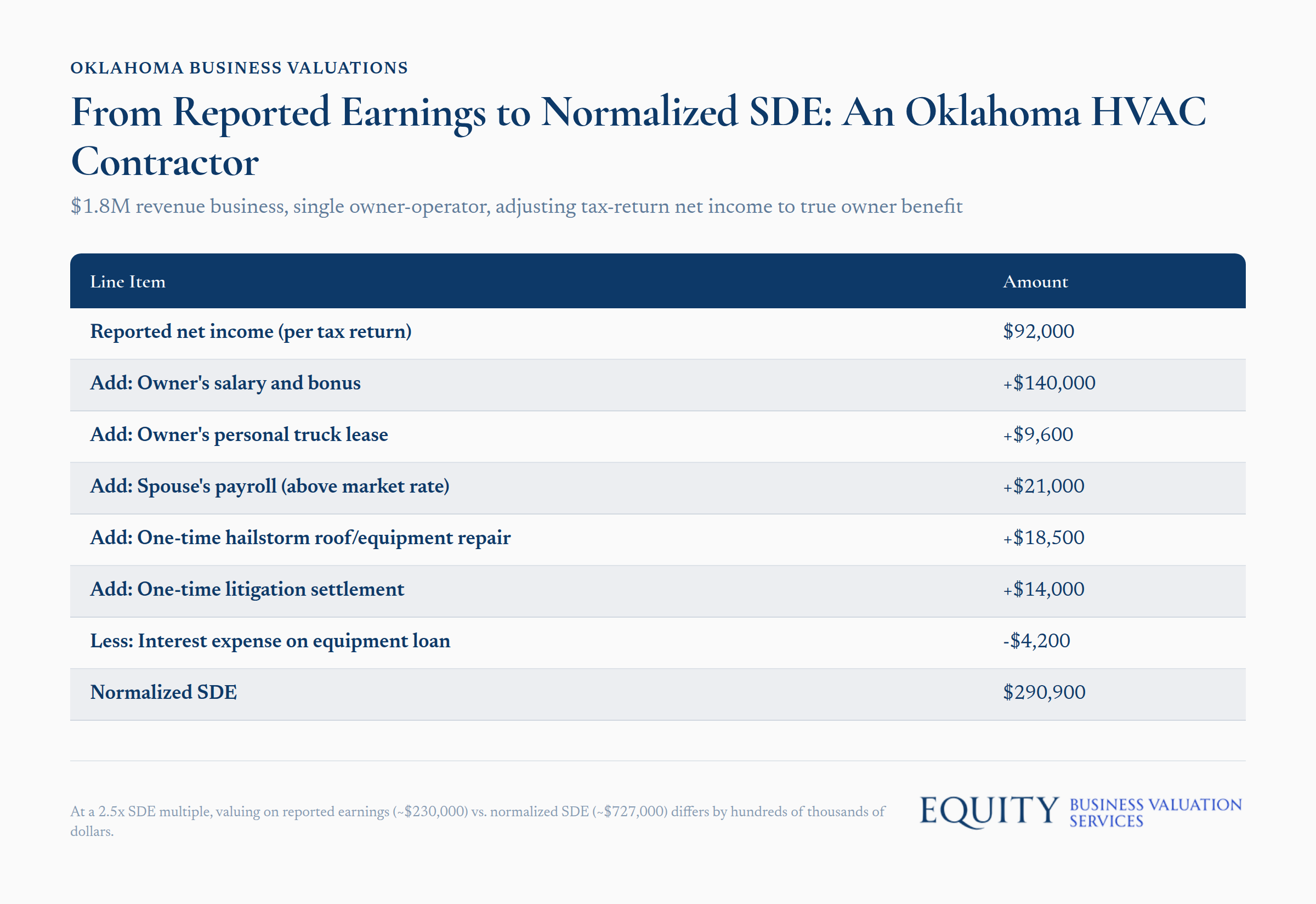
Consider a hypothetical Oklahoma HVAC and plumbing contractor with $1.8 million in annual revenue, owned and operated by a single owner who also does field work several days a week. The company's tax return shows net income of $92,000. That figure understates what the business actually generates for an owner-operator, once the discretionary and non-recurring items are identified and supported.
| Line Item | Amount |
|---|---|
| Reported net income (per tax return) | $92,000 |
| Add: Owner's salary and bonus | +$140,000 |
| Add: Owner's personal truck lease | +$9,600 |
| Add: Spouse's payroll (minimal bookkeeping duties, market rate $15,000) | +$21,000 |
| Add: One-time roof and equipment repair from spring hailstorm | +$18,500 |
| Add: One-time litigation settlement (customer dispute, isolated event) | +$14,000 |
| Less: Interest expense on equipment loan (excluded from SDE) | -$4,200 |
| Normalized SDE | $290,900 |
In this example, reported net income of $92,000 becomes normalized SDE of roughly $291,000, a difference that reflects the true owner benefit stream rather than the tax-return figure. If the applicable market multiple for a business of this size and profile is 2.5 times SDE, the difference between valuing the company on reported earnings versus normalized earnings is the difference between roughly $230,000 and roughly $727,000. That gap is the entire point of the exercise: an appraisal built on the wrong earnings base isn't slightly off, it can be off by hundreds of thousands of dollars.
What This Means for Your Business
Add-backs are not a way to inflate a business's value; they are a way to state its true earning power accurately, in either direction. A well-supported add-back schedule can raise a valuation conclusion substantially, but an owner who assumes every personal expense qualifies as an add-back, or skips the documentation, is setting up a number that won't hold up in a sale negotiation, a courtroom, or an IRS review.
If you're preparing for a sale, a divorce proceeding, an estate filing, or simply want to understand what your Oklahoma business is actually worth, a business valuation engagement is quoted as a fixed fee after we scope the assignment, based on the complexity of the business, the number of entities involved, and whether the report needs to meet IRS-qualified standards. Owners often ask how much a business valuation should cost before they commit to the process, and the honest answer starts with getting the earnings base right first.
This article is provided for general informational purposes only and does not constitute legal, tax, or financial advice. Readers should consult a qualified attorney or CPA regarding their specific circumstances.