
Blog
How Oklahoma Assessors Value Business Personal Property for Ad Valorem Taxes
Oklahoma counties value business personal property and equipment through a cost-trend-depreciation schedule, a 15% assessment ratio, and a protest path to the county board of equalization. This guide walks through the Form 901 rendition, how assessors apply the state's valuation schedule, and when an independent appraisal can support a successful protest.
Every Oklahoma business that owns taxable equipment, furniture, fixtures, or machinery has to answer to the county assessor once a year. The process feels mechanical from the outside: you file a form, a number comes back, and you pay a tax bill. But the methodology behind that number, built on a cost-trend-depreciation schedule and a fixed assessment ratio, has real room for error, and real room for a taxpayer to push back. Understanding how that number gets built is the first step toward knowing whether it's right.
What the State's Valuation Schedule Actually Does
Oklahoma county assessors value taxable business personal property using the Oklahoma Tax Commission's statewide Business Personal Property Valuation Schedule. The schedule takes the historical cost you report, trends it to an estimated replacement cost new, and then applies a depreciation factor to arrive at an estimate of fair market value, as laid out in the 2026 Business Personal Property Valuation Schedule.
The schedule is organized by asset category, with a replacement cost new figure and an expected economic life assigned to each class of equipment. From there, a depreciation table converts age into a percent-good factor. The process is uniform on paper, but it is explicitly designed as a mass appraisal aid rather than a final word on any single taxpayer's property.
The Cost-Trend-Depreciation Method, Step by Step
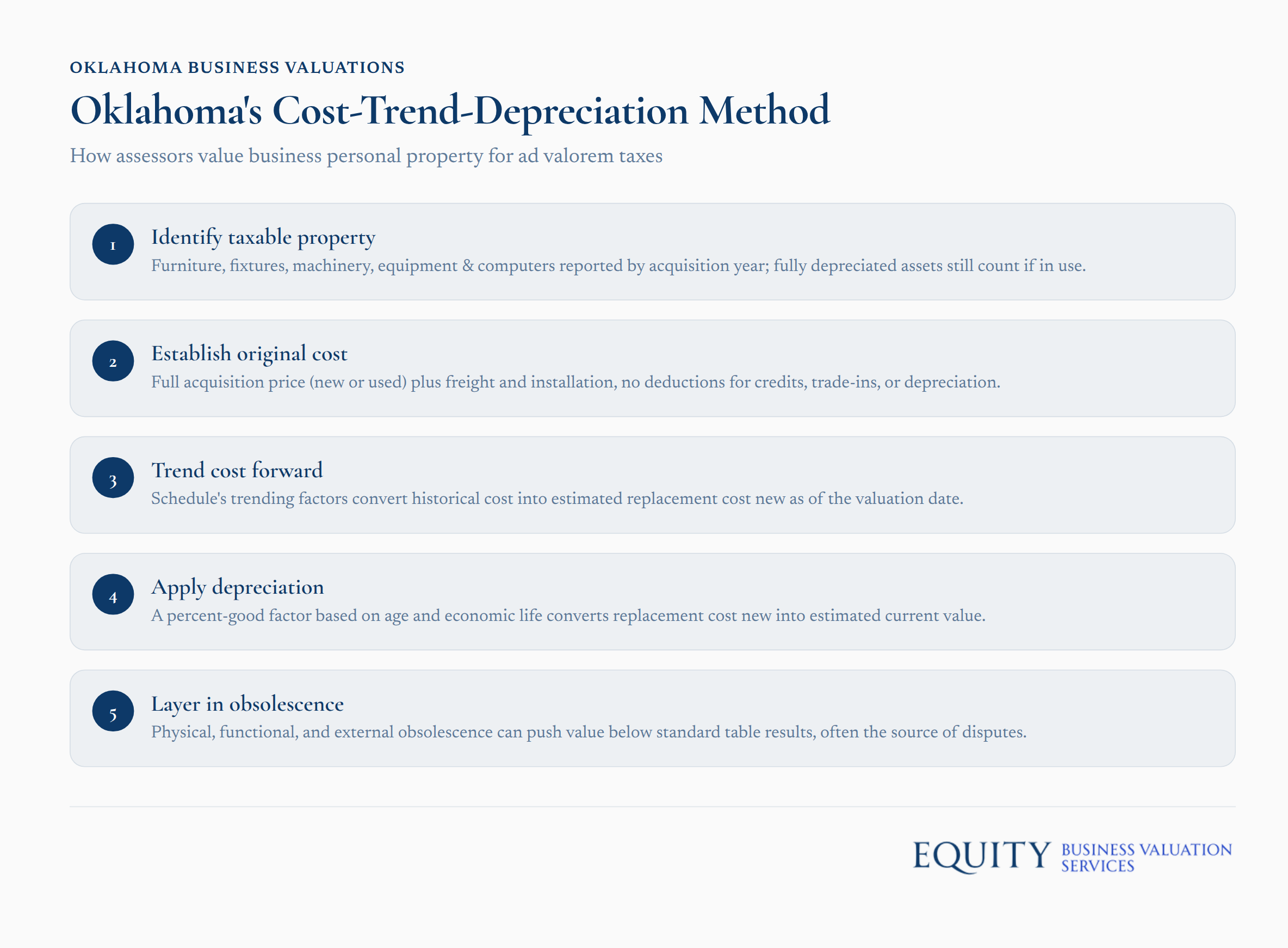
- Identify the taxable property. Furniture, fixtures, machinery, equipment, computers, and similar business-use tangible personal property get reported by the year acquired. Fully depreciated assets still count if they remain in use.
- Establish original cost. Original cost means the full acquisition price, new or used, including freight and installation, without subtracting investment credits, trade-in allowances, or your own accounting depreciation.
- Trend the cost forward. The schedule's trending factors convert that historical cost into an estimated replacement cost new as of the current valuation date.
- Apply depreciation. A percent-good factor tied to the asset's age and economic life converts replacement cost new into an estimated current value.
- Layer in obsolescence. Physical deterioration beyond normal wear, functional obsolescence (equipment that works but is no longer efficient or desirable), and external obsolescence (conditions outside the business, like a declining local industry) can all push value below what the standard tables would otherwise produce.
That fifth step is where most disputes start. The tables handle ordinary wear well. They do a much poorer job capturing a press that's technically functional but can't compete with newer equipment, or a fleet of restaurant equipment sitting in a location where the surrounding market has collapsed.
Form 901: What You Must Report and By When
Oklahoma business owners report taxable fixed assets each year on Form 901, listing everything on hand as of January 1. County assessor instructions make clear that you report original cost without reducing it for depreciation, trade-ins, or investment credits, and that fully depreciated assets stay on the rendition if they're still in use or on site, per the Oklahoma County Assessor's instruction sheet.
Renditions are due early in the calendar year, and the assessment date itself never moves: whatever you owned on January 1 is what gets valued, even if you sell the equipment in February. If a piece of property has facts the standard schedule won't capture, such as unusual condition, a documented lack of utility, or a different market value you can support, the county instructions direct you to attach a separate depreciation schedule or supporting documentation rather than simply accepting the table result.
Keeping clean acquisition records matters here just as much as it does for any other valuation exercise. The same documentation discipline we recommend for business valuation engagements (clear acquisition dates, original invoices, and a record of what's been retired) is exactly what makes a personal property rendition defensible if it's ever questioned.
Pro tip: Hold onto the original purchase invoice for major equipment, not just the depreciated book value from your accountant. Assessors want the full acquisition cost, and a misreported cost is one of the easiest things for an assessor's office to flag and adjust upward.
The 15% Assessment Ratio and How Your Bill Gets Calculated
Business personal property in Oklahoma isn't taxed on its full fair market value. It's taxed on an assessed value, which is a fixed percentage of that fair market value. For business personal property, Oklahoma counties apply an assessment ratio of 15 percent, the ceiling allowed under the state's ad valorem framework, as described in the Oklahoma Tax Commission's own ad valorem guidance.
Example: If the assessor's cost-trend-depreciation calculation estimates your equipment's fair market value at $200,000, the assessed value used to calculate your tax bill is $30,000 (15% of $200,000). Your local millage rate is then applied to that assessed value, not to the full $200,000.
This is why a valuation dispute over business personal property is worth the effort even when the dollar swing in fair market value looks modest. A $50,000 overstatement in estimated fair market value becomes a $7,500 overstatement in assessed value, every year, until it's corrected.
Why a Capitalization Rate Study Plays a Supporting Role, Not the Main One
Assessors occasionally supplement the cost approach with a capitalization rate study, particularly for certain income-producing property classes where a cost-based number alone might not reflect economic reality. But for the overwhelming majority of routine business personal property (office furniture, shop equipment, computers, restaurant fixtures) the cost-trend-depreciation method does the heavy lifting, and the income approach rarely enters the conversation.
That matters for taxpayers because it tells you where to focus a review. If your assessment looks too high, the likeliest culprits are a misapplied cost figure, an incorrect economic life classification, or unaccounted-for obsolescence, not a dispute over capitalization rates.
How to Protest Your Assessment at the County Board of Equalization
If you believe your business personal property has been overvalued, Oklahoma law gives you a path to challenge it. The typical sequence starts informally and escalates only if needed.
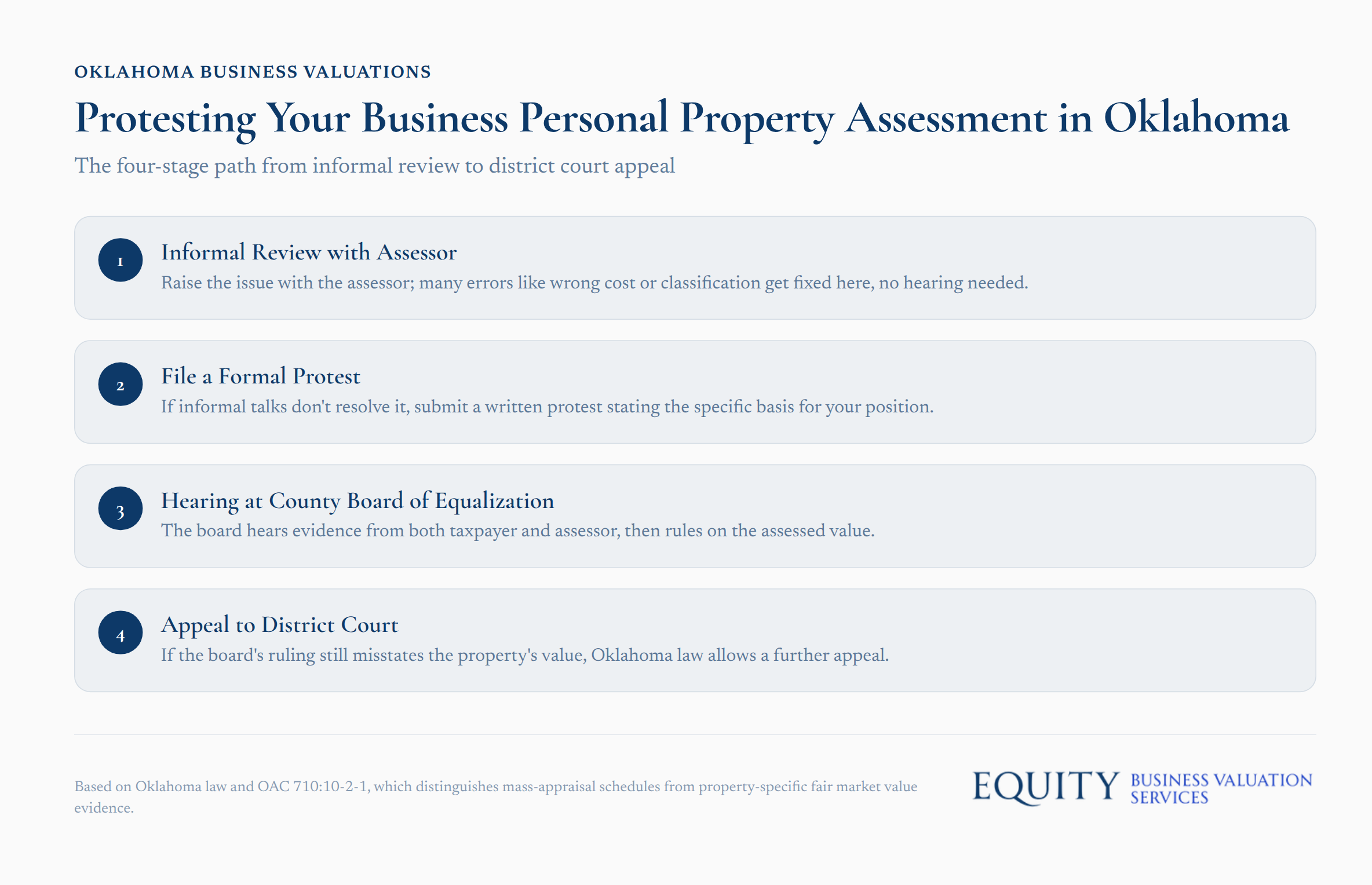
- Request an informal review with the county assessor. Many valuation errors, like a clerical mistake in reported cost or an incorrect equipment classification, get resolved at this stage without a formal hearing.
- File a formal protest. If the informal conversation doesn't resolve the disagreement, you file a written protest with the county, laying out the specific basis for your position.
- Present your case to the County Board of Equalization. The board hears evidence from both the taxpayer and the assessor's office and issues a ruling on the assessed value.
- Appeal to district court if necessary. If the board's decision still doesn't reflect the property's actual condition or value, Oklahoma law allows a further appeal.
The legal footing for this entire process rests on a simple but important distinction: the state's valuation schedule is a uniform tool meant to assist assessors, not an automatic or conclusive determination of any one taxpayer's property value. Oklahoma's implementing rule, OAC 710:10-2-1, preserves the difference between a mass-appraisal schedule and the fair market value of a specific taxpayer's assets, and it expressly allows a taxpayer to present property-specific evidence that the standard tables don't capture.
How an Independent Valuation Strengthens Your Protest
A county board of equalization is more responsive to a documented, property-specific valuation than to a general complaint that "the number feels high." An independent appraisal gives you exactly that: a USPAP-compliant report that walks through the actual age, condition, remaining useful life, and any functional or economic obsolescence affecting your specific equipment, rather than relying solely on the statewide averages built into the schedule.
Our appraisers hold credentials with organizations such as the American Society of Appraisers and the National Association of Certified Valuators and Analysts, and every valuation we prepare for an ad valorem matter follows the same standards framework we use for entity-level business valuation engagements across Oklahoma. We scope every assignment before quoting a fee, so you know the cost upfront as a fixed amount rather than an open-ended hourly bill, and the scope reflects the number of assets, the completeness of your records, and the depth of analysis the protest requires, not the dollar value of the equipment itself.
Watch out: Don't wait until the board hearing is scheduled to start gathering evidence. Obsolescence arguments in particular take time to document properly, whether that's a market comparison, a photograph record of condition, or a third-party valuation that predates the hearing by enough time to be credible.
Building a Defensible Position Before the Deadline Passes
The single most useful thing a business owner can do is treat the annual rendition and the resulting assessment as two separate decisions. Filing Form 901 accurately protects you from clerical disputes later. Reviewing the resulting valuation notice against your equipment's actual condition protects you from simply accepting a schedule result that doesn't fit your facts.
If the gap between what the schedule produced and what your equipment is actually worth is wide enough to matter, an independent appraisal is the evidence that moves a county board. We're ready to scope that engagement and quote a fixed fee once we understand the asset list and the timeline you're working against; our request an appraisal page is the fastest way to start that conversation.
This article is provided for general informational purposes only and does not constitute legal, tax, or financial advice. Readers should consult a qualified attorney or CPA regarding their specific circumstances.