
Blog
What Documents Do You Need for a Business Valuation in Oklahoma?
Gathering the right financial, tax, ownership, and customer records before your Oklahoma business valuation engagement speeds up the process and strengthens the final report. This checklist walks through exactly what to pull together and how the list changes based on why you need the valuation.
An Oklahoma business valuation only moves as fast as the records behind it. Appraisers need financial, tax, ownership, and operational documents to support whatever standard of value the engagement calls for, whether that's a sale, an estate filing, a divorce, or an SBA loan application. This guide walks through what to gather before your business valuation engagement begins, and how the list shifts depending on why you need the number.
What Financial Records Do Appraisers Need First?
Most Oklahoma business valuations start with 3 to 5 years of historical financial statements: income statements, balance sheets, and cash flow statements if your bookkeeping produces them. There is no single Oklahoma statute that fixes this at exactly 3 or exactly 5 years; the number of periods is driven by the analyst's methodology and how stable or volatile the business has been.
Alongside the annual statements, plan to provide:
- General ledgers and trial balances for the periods under review
- Current year-to-date financial statements, and monthly statements if the valuation date falls mid-year
- Accounts receivable and accounts payable aging reports
- Fixed asset schedules and depreciation records
- Budgets, forecasts, and any management projections already in use
These records let the appraiser see not just where the business ended up, but how it got there. A business with a steady climb in revenue tells a very different story than one with a single strong year propped up by a one-time contract.
Federal and Oklahoma Tax Returns That Corroborate Your Numbers
Tax returns aren't a substitute for financial statements, but they cross-check them. Appraisers use filed federal and Oklahoma returns to reconcile reported earnings, flag tax-driven accounting differences, and confirm that owner compensation and related-party payments are properly identified before any normalization adjustments are made, a step the AICPA's guidance on applying valuation standards in tax practice treats as foundational to a defensible report.
Plan to provide federal income tax returns for the relevant historical years, Oklahoma income tax returns, Schedule K-1s for pass-through entities, payroll tax filings, and sales tax returns. If the business owns equipment, inventory, or other taxable personal property, Oklahoma's ad valorem system requires separate reporting to the county assessor, and those filings can help corroborate the fixed asset values used in the valuation itself, per Oklahoma's ad valorem property tax resources.
Entity and Ownership Records: Filings and Governing Agreements
A valuation of a 100% controlling interest is a fundamentally different exercise than a valuation of a minority, non-controlling stake, so the appraiser needs paperwork that establishes exactly what interest is being valued. Gather:
- Articles of incorporation or articles of organization as filed with the Oklahoma Secretary of State, along with any amendments
- Current certificates of good standing or annual certificates
- Operating agreements, partnership agreements, or corporate bylaws
- A current ownership ledger or capitalization table, plus stock certificates or membership interest records
- Buy-sell agreements, redemption agreements, or any other transfer restrictions
- Prior valuation reports, if the business has been appraised before
Buy-sell and transfer-restriction language matters more than owners expect. A formula-based buy-sell agreement can influence how an appraiser treats value for certain purposes, so even an older, rarely-referenced agreement should be included in the packet.
Asset, Liability, and Operating Schedules
Beyond the core financial statements, appraisers need the schedules that sit behind the numbers: detailed fixed asset registers, inventory counts and valuation policies, notes payable and loan agreements, equipment invoices or prior appraisals, and real estate deeds or leases if the business owns or leases its facility. Material contracts also belong in this packet, including customer and supplier agreements, franchise or distribution agreements, and any employment or non-compete agreements tied to key personnel. Contract length, transferability, and dependence on a handful of employees or vendors can all move projected cash flow and risk in the analysis.
Customer Concentration Data and Confidentiality
Appraisers typically ask for a customer list broken out by revenue, flagging any customer that represents more than 10% of total revenue. A business that depends heavily on one or two accounts carries more risk than one with a broad, diversified customer base, and that risk shows up directly in the concluded value.
Pro tip: If a customer list is commercially sensitive, ask your appraiser about providing it in anonymized form, labeled by revenue tier or account number rather than by name, under a confidentiality agreement. The concentration analysis works the same way whether the appraiser sees "Customer A, 22% of revenue" or the actual company name; what matters is the percentage, not the identity.
How the Document List Changes by Valuation Purpose
The purpose of the engagement, not a fixed statewide checklist, ultimately controls what gets requested. AICPA guidance on valuation engagements identifies the subject entity, the specific ownership interest, the valuation date, the intended use, and the applicable standard of value as the core items that must be settled before work begins, and those decisions shape everything that follows, per the AICPA's Statement on Standards for Valuation Services.
- Sale or shareholder buyout: Add the letter of intent or purchase agreement, proposed deal terms, and any prior offers or indications of value.
- Estate or gift tax matters: Add the gift or estate tax filings, transfer documents, and records establishing ownership immediately before or after the transfer.
- Divorce and litigation: Add court orders, pleadings, discovery responses, and sworn financial statements. Our business valuation work in Oklahoma divorce cases regularly starts from this expanded packet because the court needs to see how the marital estate's business interest was analyzed, not just the final number.
- SBA financing or lender review: Add debt covenant calculations, updated forecasts, and any collateral documentation the lender has specified.
- Buy-sell or succession planning: Add existing buy-sell formulas, key-person arrangements, and management transition documents.
Engagement letters also distinguish a full valuation engagement from a more limited calculation engagement, a distinction the AICPA's valuation standards toolkit treats as central to scoping the assignment correctly, and that distinction affects how much documentation the analyst will need and how the final report reads. A well-drafted engagement letter should spell out the subject interest, the valuation date, intended users, and what information the client is expected to supply, so there's no ambiguity mid-engagement about what's still missing.
Document Categories at a Glance
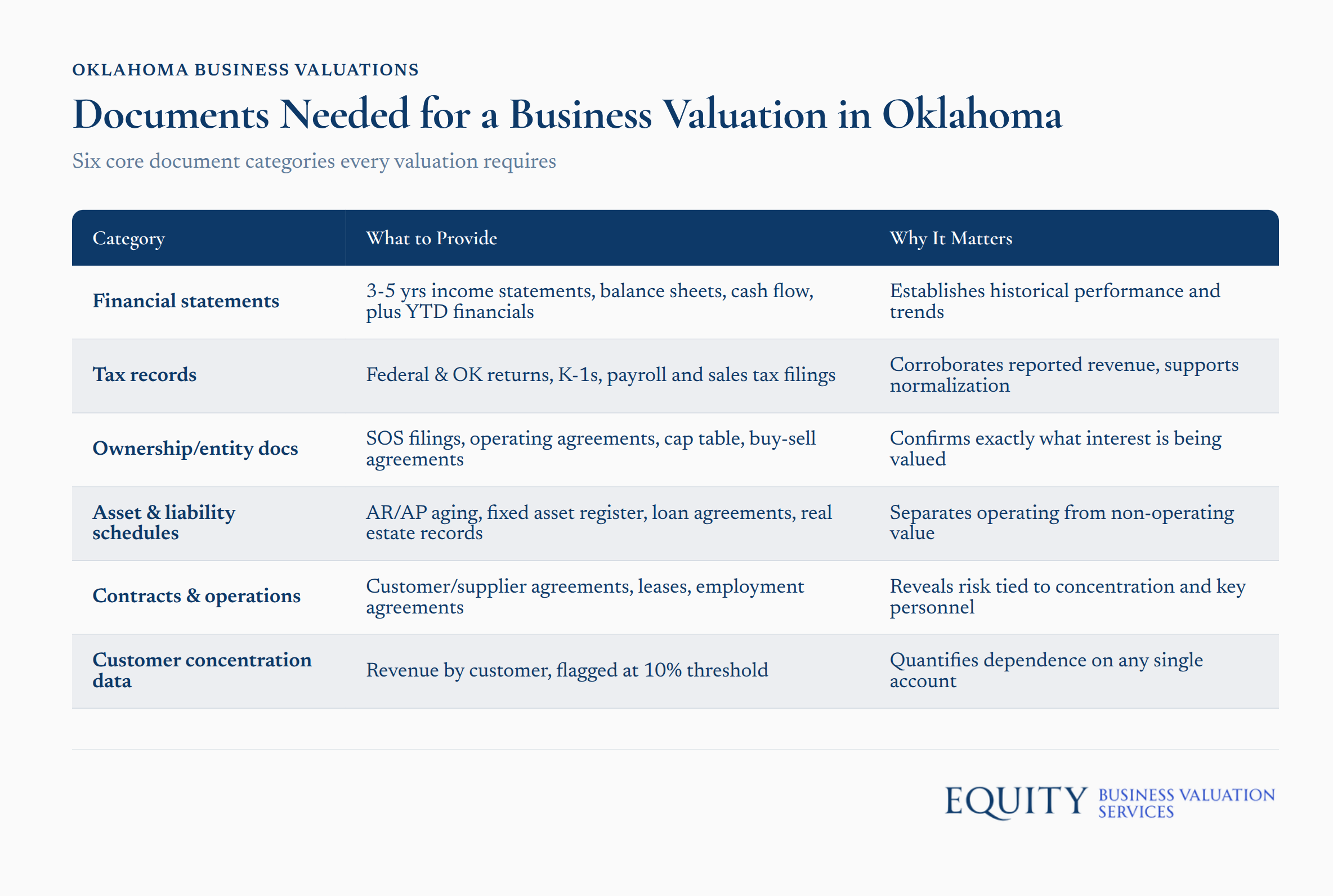
The table below summarizes the core categories most Oklahoma business valuations require, regardless of purpose.
| Category | What to Provide | Why It Matters |
|---|---|---|
| Financial statements | 3-5 years of income statements, balance sheets, cash flow statements, plus YTD financials | Establishes historical performance and trends |
| Tax records | Federal and Oklahoma returns, K-1s, payroll and sales tax filings | Corroborates reported revenue and supports normalization |
| Ownership and entity documents | Secretary of State filings, operating agreements, cap table, buy-sell agreements | Confirms exactly what interest is being valued |
| Asset and liability schedules | AR/AP aging, fixed asset register, loan agreements, real estate records | Separates operating from non-operating value |
| Contracts and operations | Customer and supplier agreements, leases, employment agreements | Reveals risk tied to concentration and key personnel |
| Customer concentration data | Revenue by customer, flagged at the 10% threshold | Quantifies dependence on any single account |
How to Gather Your Documents Before the Engagement
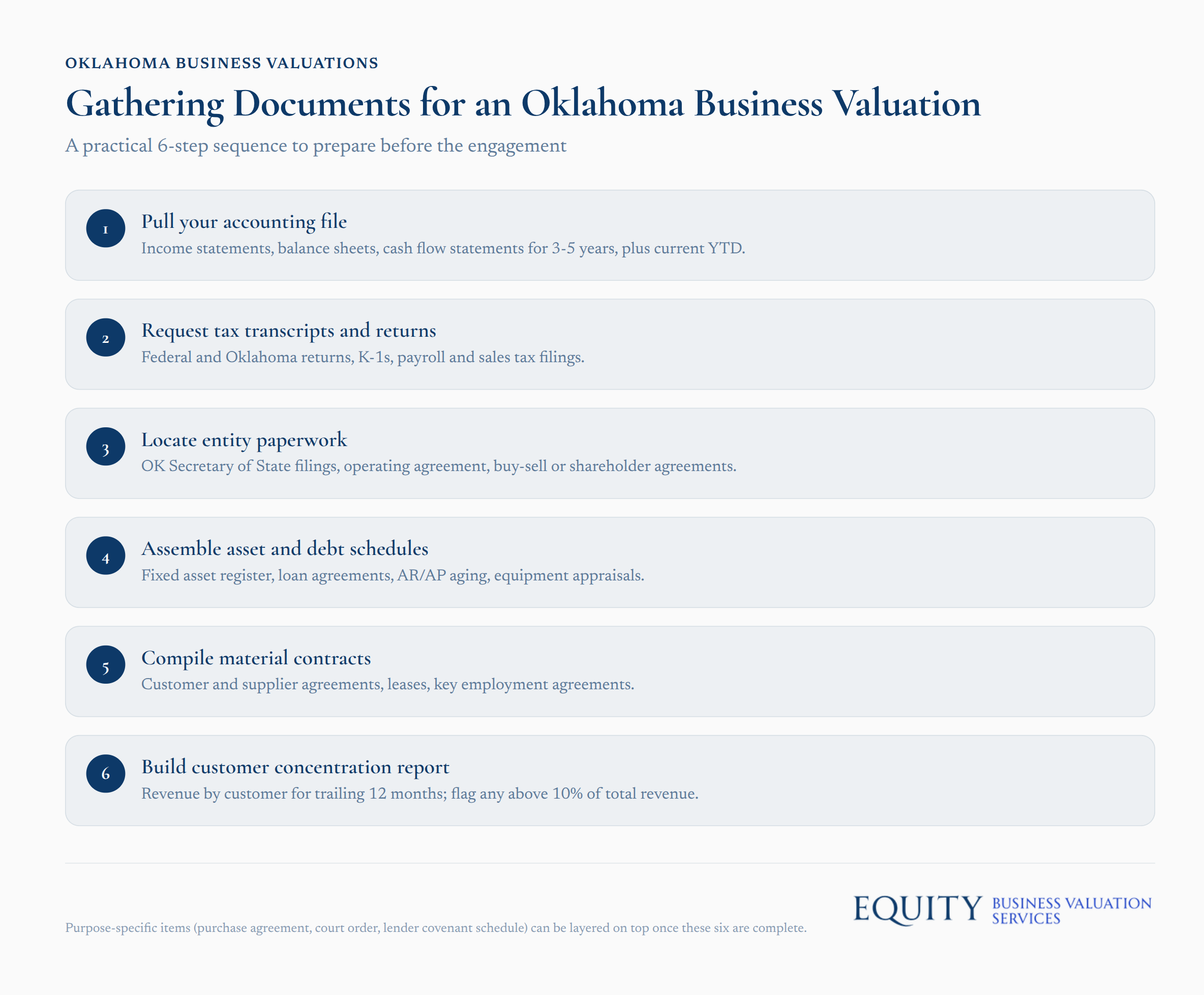
Most owners find it easier to work through the request in a fixed order rather than jumping between categories. A practical sequence looks like this:
- Pull your accounting file first. Export income statements, balance sheets, and cash flow statements for the last 3 to 5 years, plus a current year-to-date report.
- Request tax transcripts and returns. Gather federal and Oklahoma returns, K-1s, and payroll or sales tax filings from your accountant or tax preparer.
- Locate your entity paperwork. Find your Oklahoma Secretary of State filings, operating agreement, and any buy-sell or shareholder agreements, even if they haven't been touched in years.
- Assemble asset and debt schedules. Pull the fixed asset register, loan agreements, AR/AP aging, and any equipment appraisals on file.
- Compile your material contracts. Gather customer and supplier agreements, leases, and employment agreements for key staff.
- Build the customer concentration report. List revenue by customer for the trailing 12 months and flag anyone above 10% of total revenue.
Once these six categories are in hand, most of the standard document request is satisfied, and any purpose-specific items (a purchase agreement, a court order, a lender's covenant schedule) can be layered on top.
What This Means for Your Appraisal Timeline and Fee
Appraisal engagements are quoted as a fixed fee before work begins, never billed hourly. What drives that fee is the scope of the assignment: the complexity of the entity, how complete and organized the records are, the number of entities or interests involved, whether the report needs to be IRS-qualified, and how much analysis the purpose requires. A well-organized document packet doesn't change the value of the business, but it does shorten the time our appraisers spend chasing paperwork instead of analyzing it.
Our appraisers hold credentials with organizations such as the ASA and NACVA, and every engagement is documented and delivered in accordance with USPAP, including the information requests and workfile that support the final conclusion.
If you're preparing for a sale, an estate filing, a divorce, or a lender review, start pulling these records now and reach out to request an Oklahoma business valuation once you have the core packet together. Having the documents ready before the engagement starts is the single biggest thing an owner can do to keep the process on schedule.
This article is provided for general informational purposes only and does not constitute legal, tax, or financial advice. Readers should consult a qualified attorney or CPA regarding their specific circumstances.