
Blog
Business Valuation in Oklahoma Divorce Litigation: How Courts Decide Value
Business valuation in Oklahoma divorce cases turns on classification, timing, and goodwill, not a fixed formula. This guide walks through the statute and case law that decide how a closely held business gets divided.
Divorcing spouses who co-own or share ownership in a closely held business face a harder question than most: what is the business actually worth, and how much of that value belongs to the marriage? Oklahoma courts answer that question case by case, weighing statutory guidance, published appellate decisions, and competing expert reports. This guide walks through the legal framework, using real Oklahoma case law to show how classification, valuation timing, and goodwill drive the outcome.
Oklahoma Divides Property Equitably, Not Automatically in Half
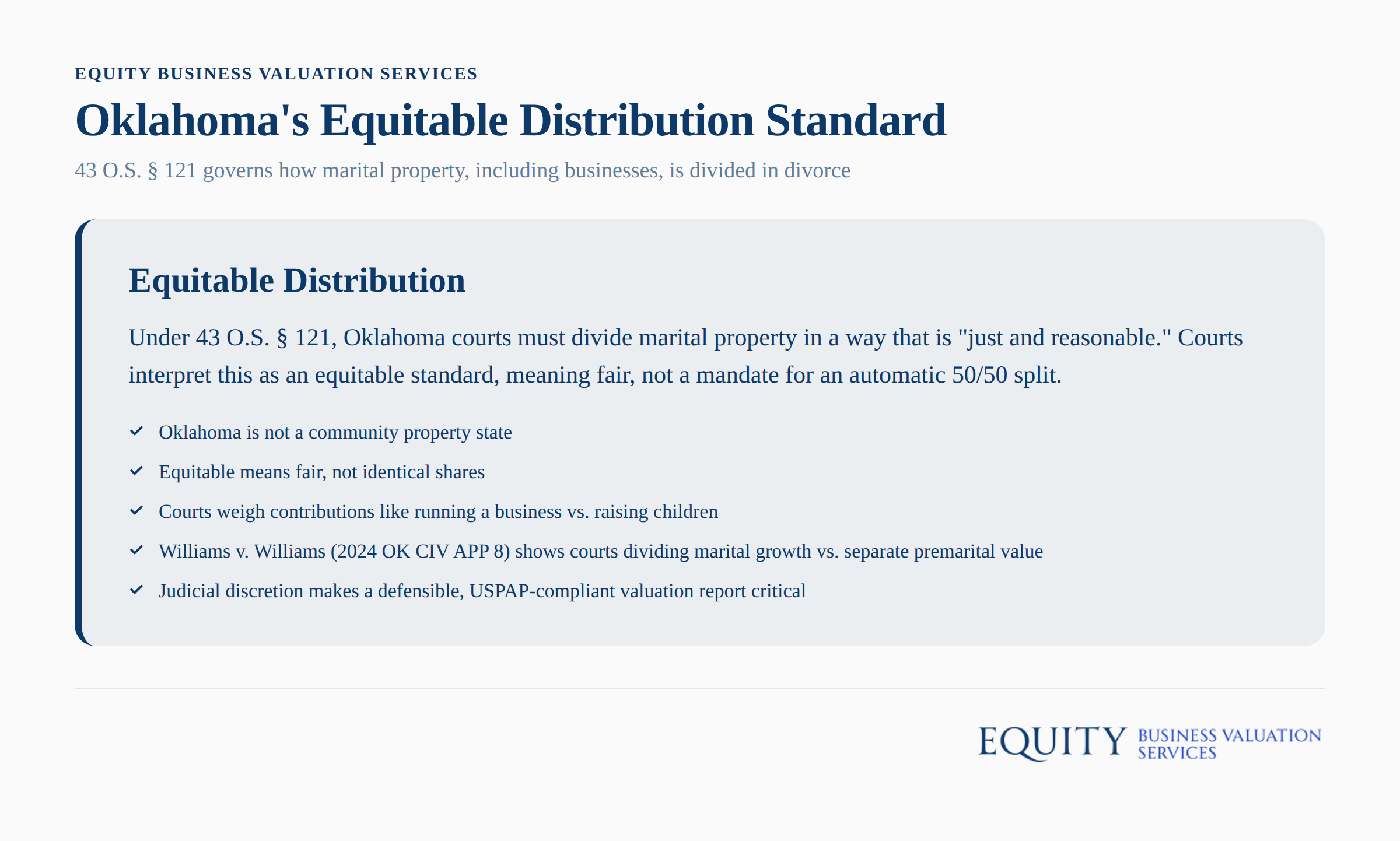
Oklahoma is not a community property state. Under 43 O.S. § 121, marital property must be divided in a way the court finds "just and reasonable," a standard courts commonly describe as equitable rather than automatically equal. That distinction matters enormously in business divorces, where one spouse may have built or run the company while the other worked, raised children, or contributed in less visible ways.
Oklahoma appellate courts have reinforced that equitable does not mean identical. In Williams v. Williams, 2024 OK CIV APP 8, the Oklahoma Court of Civil Appeals worked through exactly this kind of dispute: a business formed before the marriage, with one spouse's ownership interest predating the wedding and the other spouse's involvement growing substantially during the marriage. The court had to decide how much of the business's growth in value belonged to the marital estate versus the spouse who started it alone.
Because the statute leaves so much to judicial discretion, a well-prepared, USPAP-compliant valuation report carries real weight in these cases. That is the core of what our Oklahoma business valuation team prepares: a defensible, standards-based opinion of value built for litigation, not a back-of-envelope estimate.
Classifying the Business: Marital Property vs Separate Property
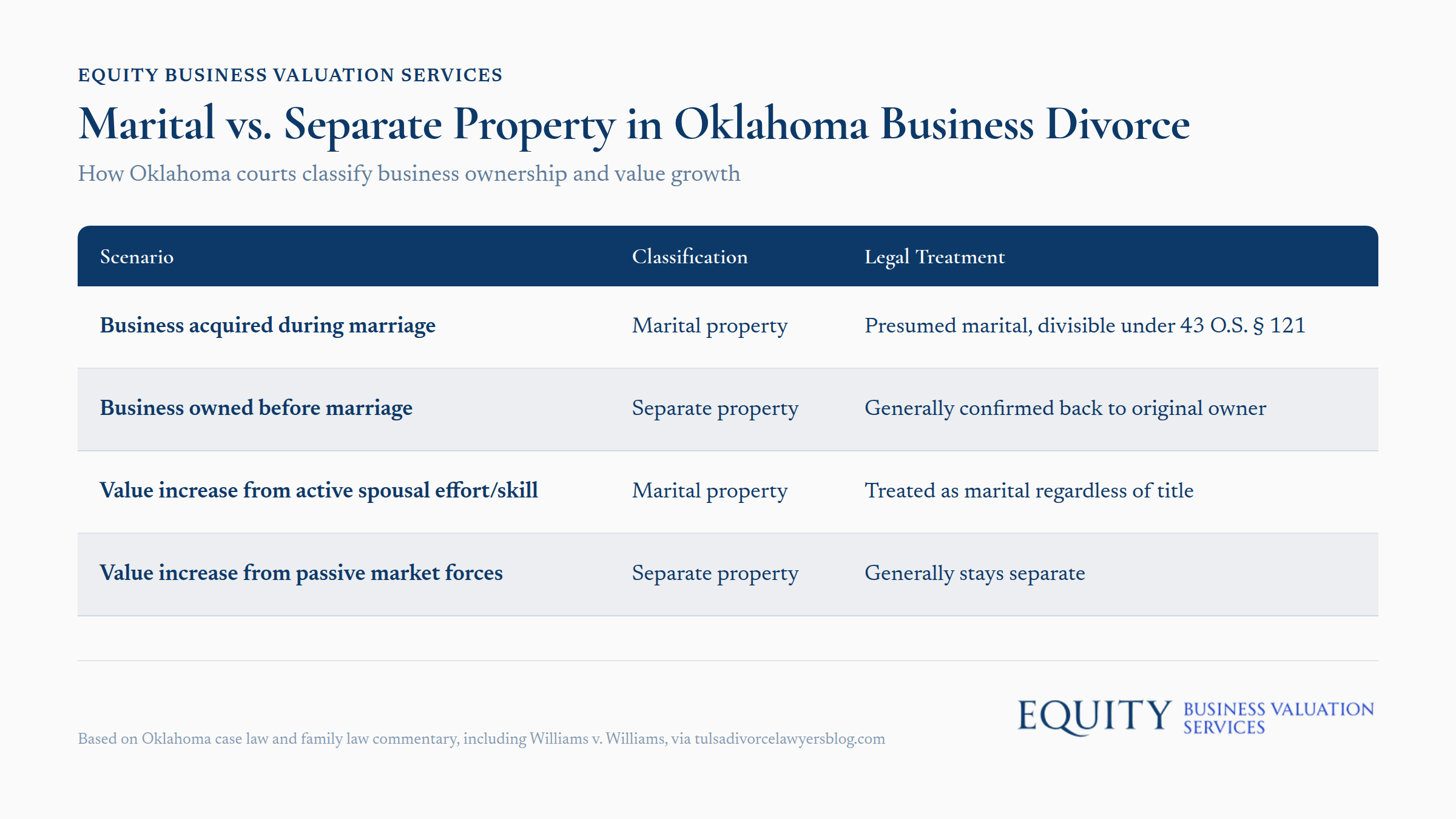
The first legal question in any business divorce is classification, and it comes before valuation methodology even enters the conversation. Property acquired during the marriage is presumed marital and subject to division. Property one spouse owned before the marriage is generally treated as separate property and confirmed back to that spouse.
The wrinkle is what happens when a separately owned business grows in value during the marriage. Oklahoma courts have held that an increase in value attributable to either spouse's active efforts, skill, or labor during the marriage becomes part of the marital estate, even if the underlying ownership interest itself stays separate (a principle traced through Oklahoma case law addressing marital contribution to a spouse's separate business). An increase caused by passive market forces, such as a business simply becoming more valuable because of industry trends, generally stays separate property.
Example: In Williams v. Williams, the business existed before the marriage and the wife's role in its early years was minimal. But her active, ongoing involvement during the marriage contributed materially to the company's later growth. That distinction, between value the business would have gained anyway and value created by marital effort, is precisely what Oklahoma courts have to untangle in these disputes, as Oklahoma family law commentary on closely held business division confirms.
A rough framework for how Oklahoma courts sort business value looks like this:
- Property acquired during the marriage: presumed marital and divisible under 43 O.S. § 121.
- Property owned before the marriage: generally confirmed to the original owner as separate property.
- Increase in value from active spousal effort: treated as marital, regardless of who holds title.
- Increase in value from passive market appreciation: generally stays separate property.
Why the Valuation Date Can Change the Outcome
Oklahoma has no statutory rule fixing a single valuation date for a marital business. The trial court has discretion to choose the date of separation, the date of trial, or the date the decree is entered, based on what it considers reasonably just given the facts of the case.
That discretion is not a technicality. It can change the outcome by tens or hundreds of thousands of dollars. Colclasure v. Colclasure, 2012 OK 97, shows why. After the husband was terminated from the family business, he formed a competing company and, according to the record, diverted resources and opportunities toward it. The Oklahoma Supreme Court's decision had to weigh dueling expert valuations: one side applied an income-based excess earnings method, the other a capitalized cash flow method, and each produced a different number depending partly on which date and which set of post-separation facts the expert used. The trial court ultimately valued the business at $480,000, a figure the Supreme Court found supported by the record.
The lesson for anyone facing a business divorce in Oklahoma is straightforward: the timing of the valuation, and what conduct occurred around that date, can be as consequential as the valuation method itself. A spouse who diverts business opportunities or resources after separation may find that conduct weighed directly into which date, and which numbers, the court ultimately relies on. General guidance on how Oklahoma courts approach the resulting methodology choices is available from Oklahoma family law practitioners writing on business valuation methods.
Enterprise Goodwill vs. Personal Goodwill
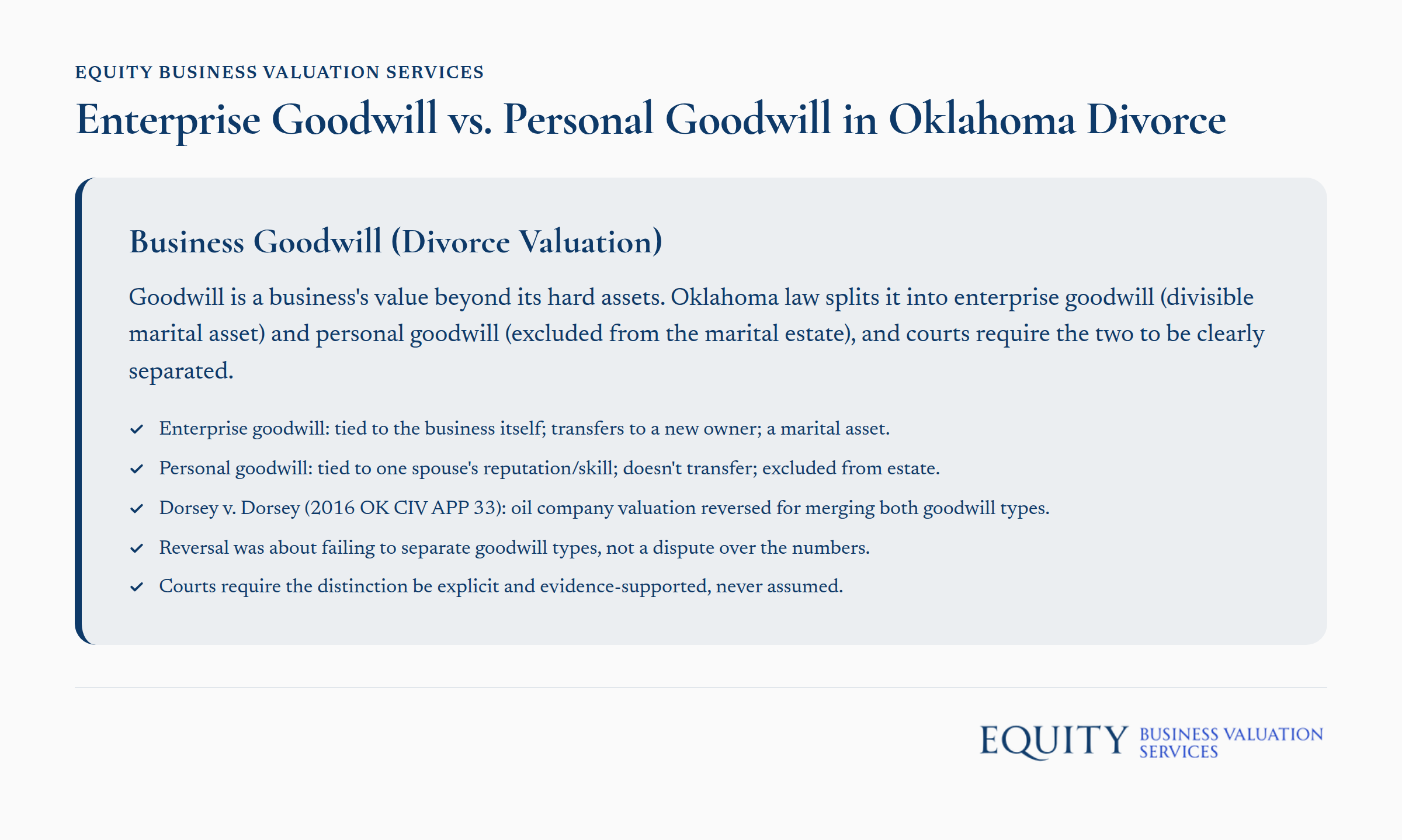
Goodwill, the value a business carries beyond its hard assets, is one of the most contested components of a business valuation in divorce. Oklahoma law distinguishes between two very different kinds of goodwill, and getting this distinction wrong can unravel an entire valuation on appeal.
Enterprise goodwill attaches to the business itself: its brand, customer base, location, and operations, all of which would transfer to a new owner. It is a marital asset subject to division. Personal goodwill, by contrast, is tied to one spouse's individual reputation, relationships, and skill. It does not transfer with a sale and Oklahoma courts generally exclude it from the marital estate.
Dorsey v. Dorsey, 2016 OK CIV APP 33, is the case that makes this distinction unavoidable. The trial court's valuation of an oil company was reversed on appeal because the wife's expert failed to separate enterprise goodwill from the husband's personal goodwill, folding both into a single number presented to the court. That failure, not a disagreement over the underlying numbers, was enough to send the valuation back. As one summary of how Oklahoma courts treat goodwill in property division puts it, the distinction has to be explicit and evidence-supported, not assumed.
How Courts Weigh Competing Expert Valuations
Oklahoma trial courts have broad discretion to weigh competing expert testimony, and appellate courts disturb that weighing only when it runs clearly against the evidence in the record. Traczyk v. Traczyk, 1995 OK 22, established the underlying standard for property classification that Oklahoma courts still apply, and Colclasure confirmed the deference appellate courts give to a trial court's chosen valuation once it is grounded in the record.
In practice, that means the trial judge is not obligated to accept either spouse's expert number outright and can adopt a value somewhere between the two, or reject an expert's methodology entirely if it is not well supported. Business valuation experts working in Oklahoma divorce litigation typically rely on three recognized approaches, described in the Oklahoma Bar Journal's overview of valuation practice:
- Income approach: capitalizes or discounts the business's expected future earnings or cash flow.
- Market approach: compares the business to sales of similar companies or interests.
- Asset-based approach: totals the fair market value of the business's underlying assets, net of liabilities.
Credentialed appraisers commonly draw on standards from organizations such as the American Society of Appraisers and the National Association of Certified Valuators and Analysts when applying these methods, and courts generally give more weight to a report that documents its methodology clearly than to one that simply states a conclusion.
Practical Guidance for Oklahoma Business Owners and Attorneys
The cases above share a common thread: valuations get overturned or discounted when the underlying evidence is thin, when goodwill is not properly separated, or when the valuation date and its surrounding facts are not clearly justified. A few practical steps reduce that risk.
- Engage a credentialed valuation expert early, before positions harden and before the valuation date becomes a moving target.
- Build a complete evidentiary record, including financial statements, tax filings, customer contracts, and documentation of each spouse's role in the business over time.
- Address goodwill head-on, asking the expert to explicitly separate enterprise goodwill from any value tied to a spouse's personal reputation or skill, exactly the step the expert missed in Dorsey.
- Understand who is doing the valuation. A CPA who prepares tax returns for the business is not necessarily trained in the same valuation methodology a court expects in litigation; our guide on whether a CPA can perform a business valuation walks through that distinction in more detail.
Business valuation engagements for divorce and litigation are quoted as a fixed fee after scoping the assignment, never billed hourly. Straightforward engagements often start around $4,500, with most matters running $7,500 to $12,000 depending on the complexity of the business, the number of entities or ownership interests involved, and the depth of analysis required; valuations involving disputed goodwill, multiple entities, or extensive post-separation conduct can run $15,000 to $20,000 or more. Full detail on how scope drives fee is available on our business valuation pricing page, and see how much you should pay for a business valuation for a closer look at typical cost ranges.
The Bottom Line for Business Owners Facing Divorce
Oklahoma's equitable distribution framework gives trial courts real discretion over how a business gets classified, when it gets valued, and how goodwill factors into the number. That discretion cuts both ways: a well-documented, methodology-driven valuation can hold up on appeal, while a rushed or incomplete one, even from an experienced expert, can be reversed. Our valuation team prepares reports built to withstand that scrutiny, using accepted income, market, and asset-based approaches and documenting every classification and goodwill decision along the way. If a business is part of your Oklahoma divorce, request an appraisal to get a fixed-fee, litigation-ready valuation scoped to your case.
This article is provided for general informational purposes only and does not constitute legal, tax, or financial advice. Readers should consult a qualified attorney regarding their specific circumstances.