
Blog
How Oklahoma Probate Courts Require Business Valuations for Estate Settlement
Oklahoma probate courts require a decedent's business interest to appear in the estate inventory at fair market value, and a written demand from any interested party can force a formal appraisal. Here's when Title 58 turns a simple inventory entry into a full business valuation, and what that report has to satisfy for both the court and the IRS.
When a business owner dies in Oklahoma, their ownership stake doesn't disappear from the estate just because there's no buyer lined up. It has to be counted, valued, and reported to the probate court like any other asset, and in practice that's where a lot of estates run into trouble.
Our Oklahoma business valuation team gets called into probate matters after a personal representative realizes that a family energy company, a farm operation, or a small manufacturing business can't simply be listed at a guessed number. This guide walks through what Oklahoma probate law actually requires, when a formal appraisal becomes mandatory, and how that valuation also feeds into federal estate tax filings.
What Oklahoma Law Requires Before an Estate Can Close
A personal representative must file an inventory, and appraisement if applicable, of the estate's assets within two months of appointment, unless the court orders otherwise. Under Title 58, Section 58-281 of the Oklahoma Statutes, the representative can satisfy the appraisement requirement by stating their own opinion of value, at least until someone objects.
That detail surprises a lot of executors. For cash accounts, vehicles, and household goods, a reasonable good-faith estimate is usually fine. A closely held business interest is a different animal. There's no listed share price, no comparable sale down the street, and the representative's personal guess carries real risk if it's ever challenged in court or by the IRS.
When Does a Formal Business Appraisal Become Mandatory?
A formal appraisal becomes mandatory the moment an heir, devisee, legatee, a creditor with a filed claim, a guardian, a conservator, a guardian ad litem, or any other interested person submits a written demand. At that point the court appoints appraisers, and the personal representative's own opinion of value is no longer sufficient on its own.
Oklahoma statute directs the judge to appoint three disinterested appraisers, though any two of them can act, and they're entitled to reasonable compensation for the work. Their duties, laid out under Title 58, include listing each estate asset separately with a value stated in dollars and cents, and that list specifically calls out "partnerships and other interests," which is the statutory category business ownership falls into.
Local Oklahoma County probate rules add one more wrinkle worth knowing: the valuation date on the original inventory and appraisal is fixed at the decedent's date of death, regardless of when the appraiser actually does the work. A business appraised eight months after death still has to reflect what it was worth on the day the owner died, not the day of the report.
Disputes over a family business's value in a probate setting tend to look a lot like the valuation fights we see in Oklahoma divorce litigation: competing opinions of value, disagreements over which approach applies, and a court that ultimately has to pick a number. The difference is that in probate, the fight is often between siblings or between heirs and a surviving business partner rather than between spouses.
The Dollar Thresholds That Shape How Much Process an Estate Needs
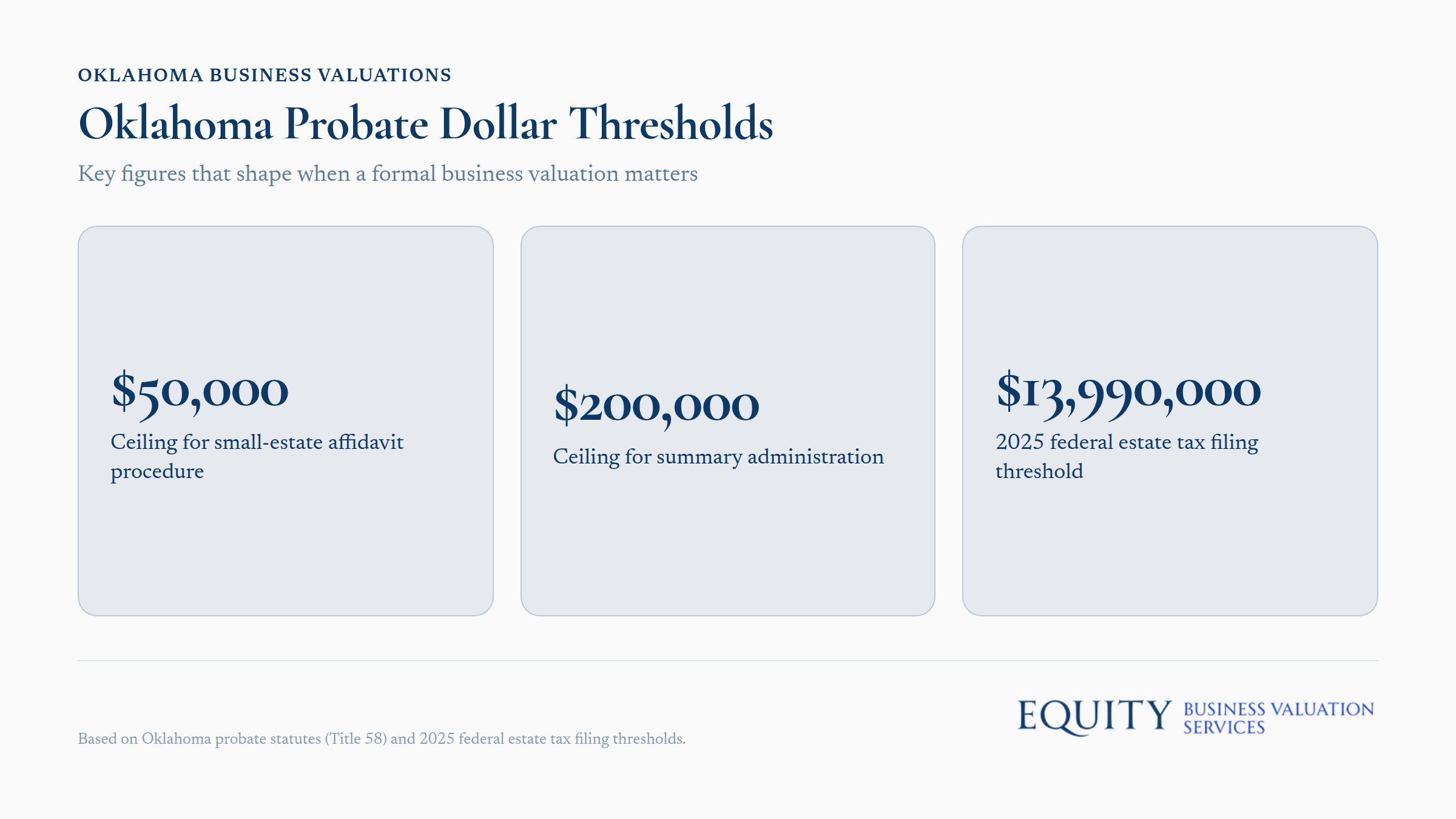
Three dollar thresholds decide how much of this process an Oklahoma estate actually has to go through, and a business interest can easily push an estate past all three.
- $50,000: Oklahoma's small-estate affidavit procedure is available when the fair market value of the decedent's Oklahoma property, less liens and encumbrances, doesn't exceed this amount. A business interest of any real value typically rules this option out on its own.
- $200,000: Oklahoma allows summary administration, a shorter court process, when the estate is valued at $200,000 or less, when the decedent has been dead more than 5 years, or when the decedent lived in another jurisdiction at death. A business ownership stake often puts an estate over this line even when the rest of the assets are modest.
- $13,990,000: This is the federal estate tax filing threshold for a decedent dying in 2025, combining the gross estate and adjusted taxable gifts. Estates below this figure generally don't owe federal estate tax, but a business interest still has to be valued accurately to prove the estate falls under the line, according to IRS guidance.
Why the Personal Representative's Opinion Often Isn't Enough for a Business
A personal representative's own estimate works fine for assets with an active market. It rarely works for a business interest, because there usually isn't a market to reference at all.
A family-owned company doesn't trade shares on an exchange, doesn't have a recent arm's length sale to point to, and often carries a buy-sell agreement or transfer restriction that affects what the interest is actually worth to anyone but the other owners. Add in a case where the estate wants to claim special-use valuation for agricultural or business real property, or where the executor is weighing the installment payment option for estate tax under Section 6166, and the stakes of getting the number right go up considerably. Those elections depend on an accurate, defensible value, not a guess.
Watch out: An executor who lists a business interest at book value, or simply divides annual revenue by a rule of thumb, is taking on personal risk. If the number is later challenged by an heir or adjusted by the IRS, the personal representative can be the one answering for it.
What Federal Estate Tax Filings Demand From a Business Valuation
When an estate is large enough to require IRS Form 706, a closely held business interest, whether it's a partnership, an LLC, an unincorporated business, or close corporation stock, needs more than a single number. The instructions require the executor to attach a statement covering the entity's assets and liabilities and net earnings for the 5 years preceding the valuation date, to account for goodwill, and to include the entity's EIN.
The underlying valuation standard is fair market value as of the date of death or the alternate valuation date, defined as the price at which the property would change hands between a willing buyer and a willing seller, with neither under compulsion and both having reasonable knowledge of the relevant facts. Treasury regulations addressing the valuation of business interests apply this same standard to partnerships and unincorporated businesses, which is exactly the category Oklahoma's probate statute uses for these assets.
Pro tip: One valuation, prepared correctly, can typically serve both purposes. A report built to a fair market value standard, with the underlying support the Form 706 instructions expect, satisfies the probate court's inventory requirement and the IRS filing at the same time. There's rarely a reason to commission two separate appraisals.
Closely Held Businesses Common in Oklahoma Estates
Oklahoma's economy shapes which kinds of businesses show up most often in these probate matters. Family-owned oil and gas interests, including working interests and mineral rights tied to a decedent's operating company, are a frequent source of valuation disputes. Agricultural operations, particularly multi-generation farms and ranches with equipment, livestock, and land held inside a family entity, present their own layered valuation questions. Manufacturing and light industrial businesses built by a single founder round out the list, often complicated by the fact that the founder's personal relationships and reputation carried much of the company's goodwill.
Each of these carries its own valuation wrinkles: mineral interests need to be separated from the operating business, agricultural entities may involve special-use valuation elections, and founder-dependent businesses need a hard look at whether goodwill transfers at all after the owner's death.
How Executors Should Move From Inventory to Defensible Valuation
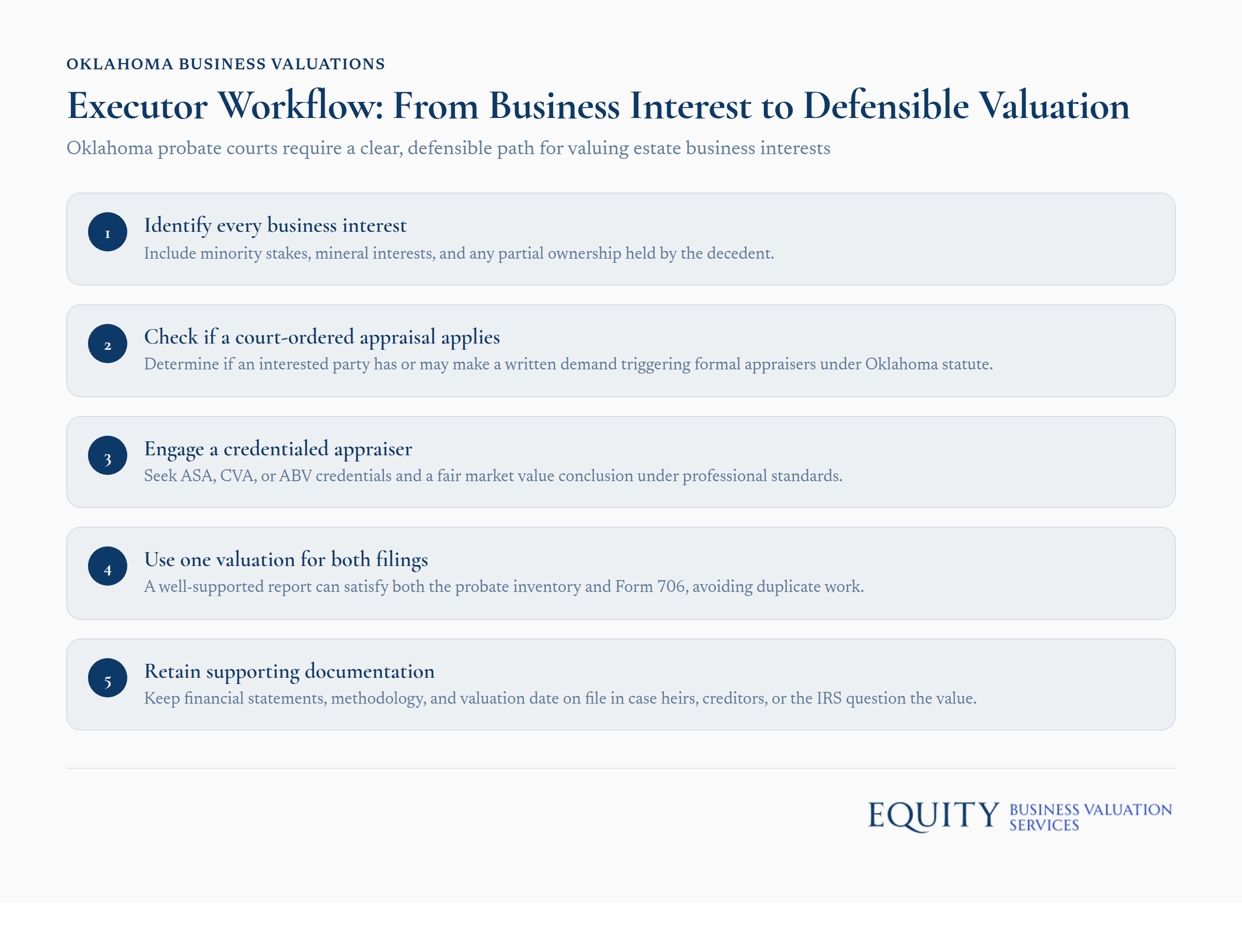
Executors dealing with a business interest in an Oklahoma estate generally need to work through the same sequence, regardless of the industry involved.
- Identify every business interest in the estate. This includes minority stakes, mineral interests, and any entity where the decedent held even a partial ownership share.
- Determine whether a court-ordered appraisal applies. Check whether any interested party has made, or is likely to make, a written demand that would trigger formal appraisers under Oklahoma probate statute.
- Engage a credentialed business appraiser. Look for credentials such as the ASA, CVA, or ABV designation, and confirm the appraiser will produce a fair market value conclusion under recognized professional standards.
- Use one valuation for both filings. A properly supported report can satisfy the probate inventory requirement and, if the estate is large enough, the Form 706 filing, without duplicating the work.
- Keep the supporting documentation with the estate file. Financial statements, the appraiser's methodology, and the valuation date should all be retained in case the value is later questioned by an heir, a creditor, or the IRS.
What a Business Valuation Costs in an Oklahoma Probate
A business valuation for probate purposes is quoted as a fixed fee after we scope the assignment, never billed hourly. Standard business valuation engagements start at $4,500, and reports built to an IRS-qualified standard, which is typically what a probate estate needs for a Form 706 filing, start at $5,500. Most closely held business engagements in a probate context land between $7,500 and $12,000, with more complex ownership structures, multiple entities, or contested valuations running $15,000 to $20,000 or more. See our Oklahoma business valuation pricing page for how these fees scale with entity complexity.
The fee reflects the scope of the engagement, meaning the number of entities involved, the completeness of the financial records, and whether the report needs to meet IRS-qualified standards, not the dollar value the business ultimately turns out to be worth. A methodology recognized by the American Society of Appraisers underlies the income, market, and asset-based approaches used to reach that conclusion, and our reports are prepared in accordance with USPAP so the resulting value holds up whether it's reviewed by a probate judge, an heir's attorney, or the IRS.
Get the Valuation Right Before the Estate Closes
A business interest sitting in an Oklahoma estate is rarely simple to value, and getting it wrong creates exposure long after the estate closes, whether that's a challenge from an heir or an adjustment from the IRS. Our Oklahoma-based appraisers prepare USPAP-compliant business valuations built for both the probate inventory and any federal estate tax filing the estate requires. If you're a personal representative facing this situation, request an appraisal and we'll scope the engagement before any work begins.
This article is provided for general informational purposes only and does not constitute legal, tax, or financial advice. Readers should consult a qualified attorney or CPA regarding their specific circumstances.