
Blog
Personal Goodwill vs Enterprise Goodwill in Oklahoma Divorce: What Counts as Marital Property
Oklahoma divorce courts divide enterprise goodwill as marital property but generally exclude personal goodwill tied to the owner's own reputation and skill. This guide explains how appraisers separate the two and why the distinction can decide what actually belongs on the marital balance sheet.
When a marriage ends and one spouse owns a business, the hardest valuation question is rarely the business's total worth. It's figuring out how much of that worth is personal goodwill vs enterprise goodwill, because Oklahoma courts treat the two very differently once the business lands in front of a judge. This guide walks through how the distinction works, which Oklahoma cases shaped it, and how our appraisers separate the two when we prepare a business valuation for an Oklahoma divorce.
What Is Enterprise Goodwill in an Oklahoma Divorce?
Enterprise goodwill is the portion of a business's value that would survive if the current owner walked away and sold the company to a stranger tomorrow. It belongs to the business itself, not to the person running it.
Think of the attributes a buyer would actually pay for: an established customer base that keeps coming back regardless of who answers the phone, a recognizable brand or trade name, a favorable lease or location, documented systems and procedures, recurring contracts, and a trained staff that stays on after a sale. Oklahoma treats this kind of value as property, and property acquired or built up during the marriage through joint effort is generally subject to equitable division under Oklahoma's marital property statute. Enterprise goodwill is the piece of the puzzle most likely to land on the marital side of the ledger.
What Is Personal Goodwill, and Why Doesn't Oklahoma Divide It?
Personal goodwill is the value that disappears, or at least shrinks sharply, the moment the owner stops showing up. It is tied to an individual's reputation, technical skill, professional license, referral relationships, or the simple fact that clients trust that specific person and nobody else.
Oklahoma courts generally decline to treat personal goodwill as a divisible marital asset because it is not independently marketable. Nobody can buy it separately from the person who generated it, which makes it look less like property and more like future earning capacity. Family law commentary on this issue describes the same functional test: if the value would not transfer to a buyer without the owner's continued involvement, it is personal, not enterprise.
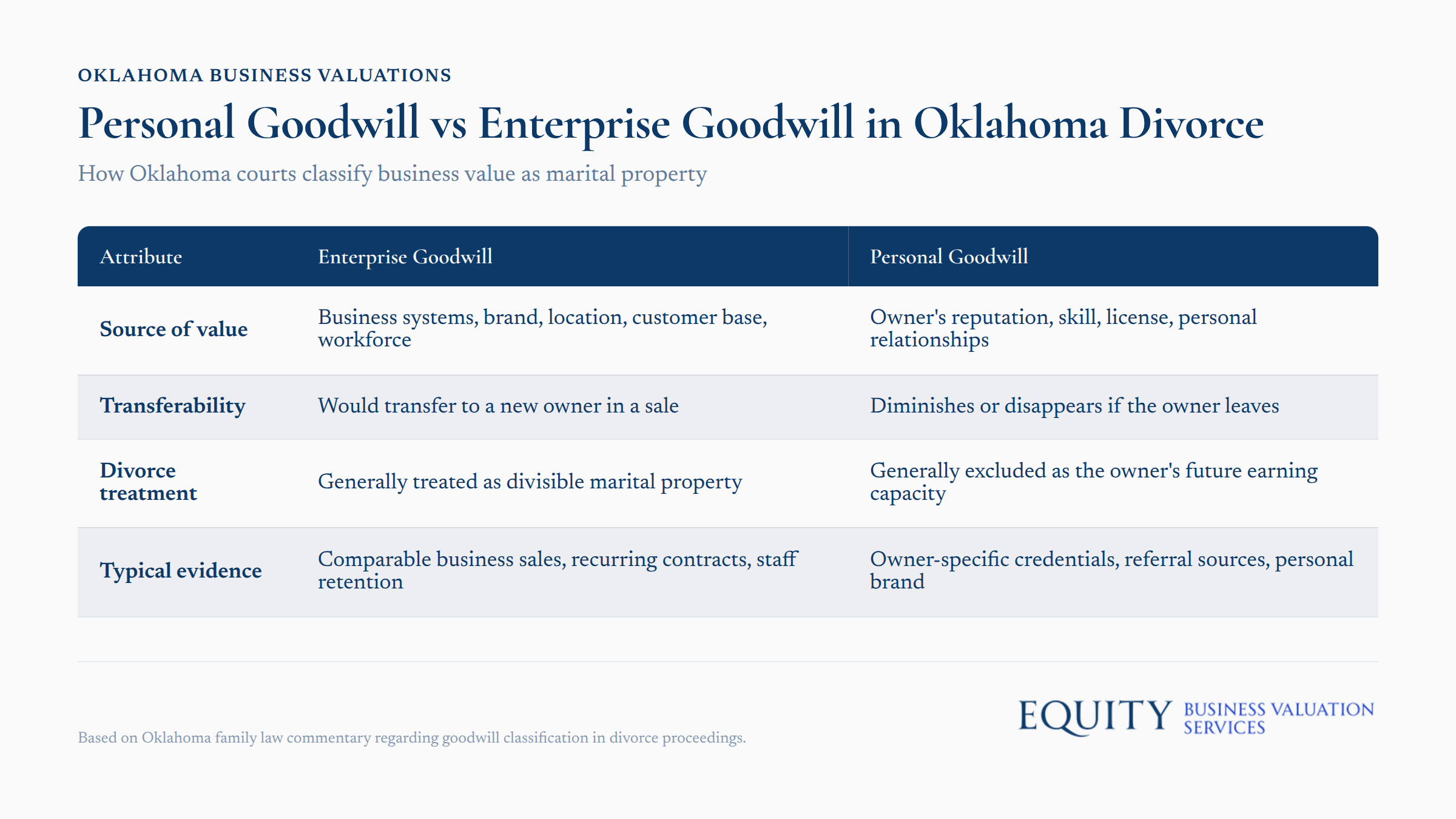
The table below summarizes how Oklahoma courts tend to approach each category.
| Attribute | Enterprise Goodwill | Personal Goodwill |
|---|---|---|
| Source of value | Business systems, brand, location, customer base, workforce | Owner's reputation, skill, license, personal relationships |
| Transferability | Would transfer to a new owner in a sale | Diminishes or disappears if the owner leaves |
| Divorce treatment | Generally treated as divisible marital property | Generally excluded as the owner's future earning capacity |
| Typical evidence | Comparable business sales, recurring contracts, staff retention | Owner-specific credentials, referral sources, personal brand |
How Oklahoma Courts Have Drawn the Line
Oklahoma has never adopted a statutory formula or fixed percentage for splitting goodwill into enterprise and personal buckets. Instead, the line has been drawn case by case, and Oklahoma attorneys have spent decades arguing over where it falls.
Two older Oklahoma Supreme Court decisions, Travis v. Travis and Mocnik v. Mocnik, are frequently cited as the starting point for this analysis. In broad terms, both cases grappled with how to separate the value that belongs to an established business concern from value that is really just a reflection of one spouse's personal standing, and both signaled that goodwill tied to continued public patronage of the business itself can be treated as property subject to division. Later appellate decisions have applied that framework more directly to the enterprise-versus-personal question. Dorsey v. Dorsey distinguished marketable business value, which can be sold or transferred, from goodwill that depends entirely on one spouse's individual reputation and is not marketable at all.
Other appellate cases have tackled the valuation mechanics that flow from this classification. One decision approved an expert's method of separating marketable goodwill supported by comparable sales data from the nonmarketable goodwill tied to the practitioner's continued presence, rejecting a lower court's finding that the two hadn't been properly distinguished. Another emphasized that a business valuation in divorce must account for how the business's value changed over the course of the proceeding, including any effects of a spouse's conduct, such as starting a competing business before the marriage formally ended.
The Oklahoma Bar Journal has flagged goodwill classification as one of the more unresolved, fact-intensive issues in Oklahoma marital business litigation, which is exactly why this question tends to draw competing experts rather than a quick answer. The parties' attorneys argue the classification, and the court weighs the evidence. Our appraisers don't make that legal call; we build the valuation record the attorneys and the court need to make it.
How Appraisers Separate Enterprise Goodwill from Personal Goodwill
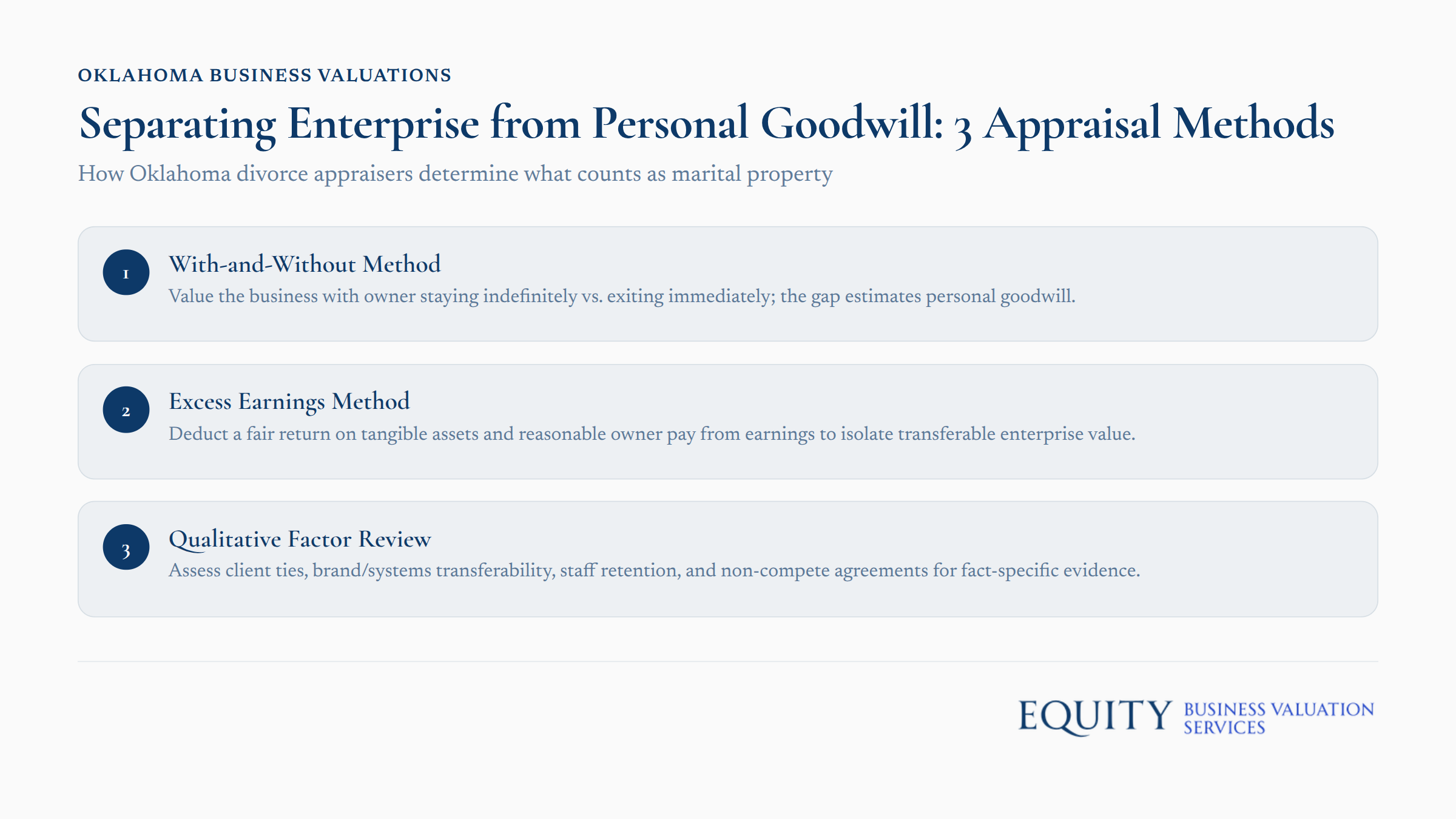
Separating the two kinds of goodwill is a methodology problem, not a guess. Appraisers generally lean on a combination of three approaches to build defensible support for where the line falls.
- With-and-Without Method
- The appraiser values the business twice: once assuming the current owner stays involved indefinitely, and once assuming the owner exits immediately after the valuation date.
- The gap between the two values is treated as an estimate of personal goodwill, since it represents the value that depends on that specific person remaining in place.
- Excess Earnings Method
- The appraiser calculates a fair return on the business's tangible assets and subtracts a reasonable owner compensation figure from total earnings, a process closely tied to the add-backs and normalization work that underlies most Oklahoma business valuations.
- What remains after those deductions is analyzed to determine how much reflects transferable enterprise earning power versus earnings that only exist because of the owner's personal labor.
- Qualitative Factor Review
- The appraiser examines whether client relationships are tied to the business or to the individual, whether the brand and systems are documented and transferable, whether staff would stay under new ownership, and whether a non-compete agreement exists that would support a sale.
- This review supplements the numeric methods and gives the court tangible, fact-specific evidence instead of a bare percentage.
Why the Classification Decides What's on the Table
This distinction is not an academic exercise. It directly determines the size of the marital estate before the court even gets to the question of how to divide it.
It also interacts with a second layer of complexity: timing. Even when goodwill qualifies as enterprise goodwill, Oklahoma courts have required a further split between value that existed before the marriage, value that grew through market conditions or passive ownership, and value that grew because of either spouse's labor or contributions during the marriage. A business that predates the marriage but grew substantially through both spouses' joint effort can still produce marital value, even if the original enterprise was separate property.
This is why a surface-level number, like a multiple of revenue or a round percentage applied to goodwill, rarely survives scrutiny in an Oklahoma courtroom. The valuation has to connect the dollar figure to specific, documented facts about transferability, timing, and the owner's role.
What This Means for Your Oklahoma Business Valuation
If you are heading into a divorce with a business on the table, expect your attorney and the other side's attorney to focus heavily on how goodwill gets classified, because that single question can shift hundreds of thousands of dollars from the marital estate to one spouse's separate future earnings, or the reverse. A valuation that does not address personal versus enterprise goodwill directly leaves that argument unanswered.
Our appraisers prepare these reports in accordance with the standards set by the American Society of Appraisers, NACVA, and The Appraisal Foundation's USPAP, with clear documentation of how enterprise and personal goodwill were separated and why. Fees for a divorce business valuation are quoted as a fixed amount after we scope the engagement, based on the complexity of the business, the quality of its financial records, and the depth of analysis the matter requires, never billed by the hour and never based on the business's ultimate value.
If you need a defensible, court-ready valuation for an Oklahoma divorce, request an appraisal and our team will walk you through the documentation we need to get started.
This article is provided for general informational purposes only and does not constitute legal, tax, or financial advice. Readers should consult a qualified attorney regarding their specific circumstances.