
Blog
Oklahoma Estate and Gift Tax Rules Every Business Owner Should Know Before a Valuation
Oklahoma has no state estate or inheritance tax, but a closely held business can still trigger federal estate and gift tax rules once an owner's estate approaches the $13.99 million exemption. Here is how fair market value, qualified appraisals, and the adequate disclosure rule affect your valuation.
If you own a closely held business in Oklahoma, energy services, a family farm, a manufacturing shop, or an agribusiness, you have probably heard that Oklahoma does not tax estates. That part is true. What often gets missed is that the federal government still does, and the valuation placed on your business is the single number that determines whether your estate or your lifetime gifts cross that federal line. This guide walks through what actually applies, what does not, and where a defensible business valuation fits into the picture.
Does Oklahoma Have a State Estate or Inheritance Tax?
No. Oklahoma repealed its state estate tax, with the repeal fully effective for deaths occurring on or after January 1, 2010, and the state levies no inheritance tax either. Lawmakers phased out the old estate tax act over several years before eliminating it entirely, and legislative summaries confirm the change was designed to keep Oklahoma competitive with neighboring states that had already dropped their own estate taxes (Oklahoma Senate press release). For deaths after that date, no Oklahoma estate tax lien attaches to property passing through the estate, and no separate state release is needed to keep title marketable.
Oklahoma also imposes no state gift tax. Estate planning summaries covering the state confirm that planning for Oklahoma business owners is built entirely around federal transfer tax rules, not a parallel state regime (state estate planning overview). That is good news for the paperwork side of things. It does not mean valuation stops mattering.
The Federal Estate Tax Exemption That Actually Matters
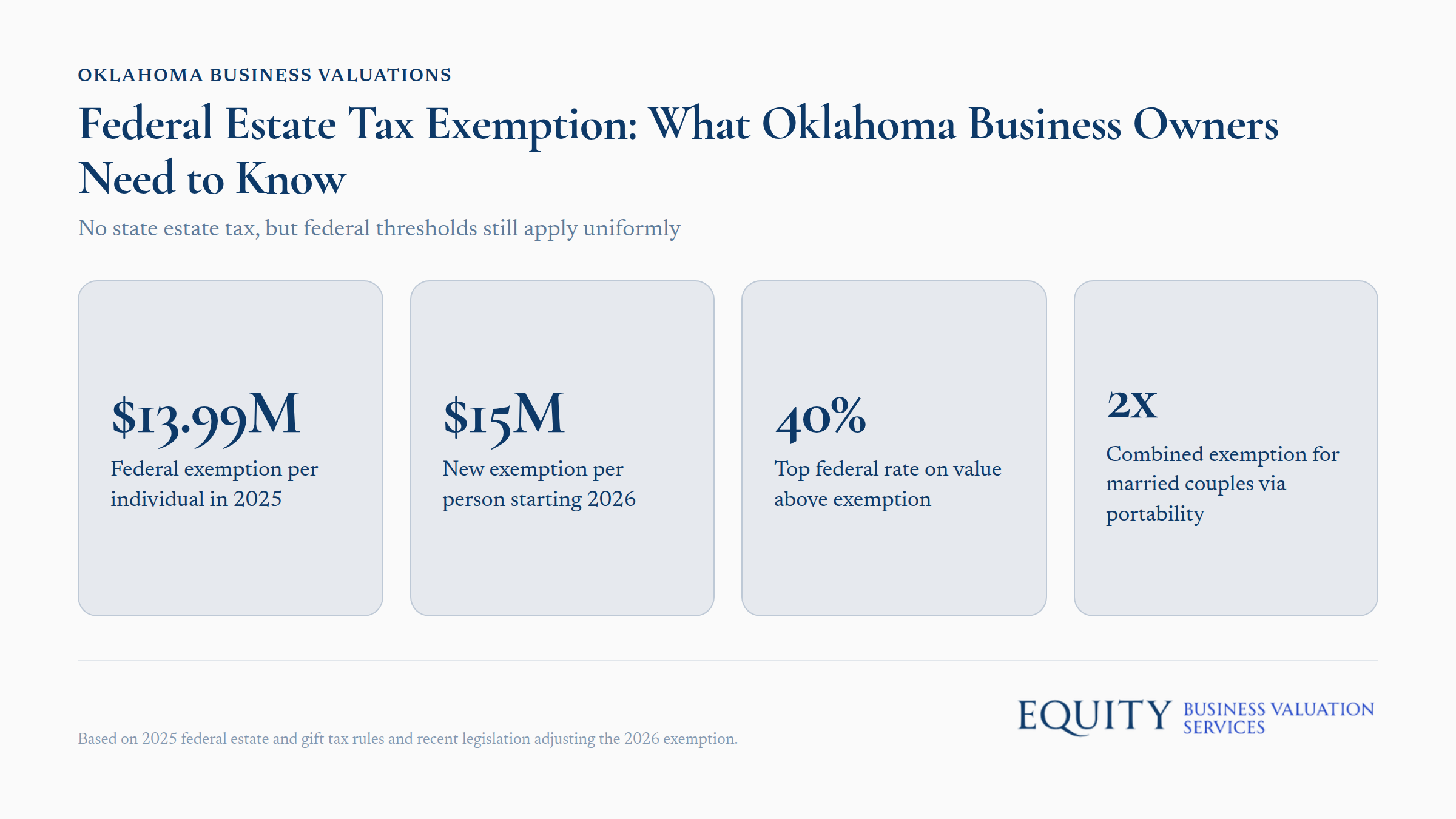
Even with no state tax, a closely held Oklahoma business can still land inside the federal estate and gift tax system once an owner's total estate, including the business, approaches the federal exemption. For 2025, that exemption sits at $13,990,000 per individual, with a top federal rate of 40% on value above the threshold, and recent legislation raises the exemption to $15 million per person for 2026. Married couples can combine exemptions through portability, effectively doubling the amount that passes free of federal estate tax when the surviving spouse's estate is settled. None of this is optional or negotiable once an estate is over the line: the IRS applies these thresholds uniformly regardless of which state the decedent lived in.
The exemption numbers move most years, so an appraisal completed two or three years before a transfer can rest on assumptions that no longer hold. That is one reason valuations for estate and gift planning are usually refreshed close to the date they will actually be used, rather than treated as a one-time exercise.
How the IRS Defines Fair Market Value for a Closely Held Business
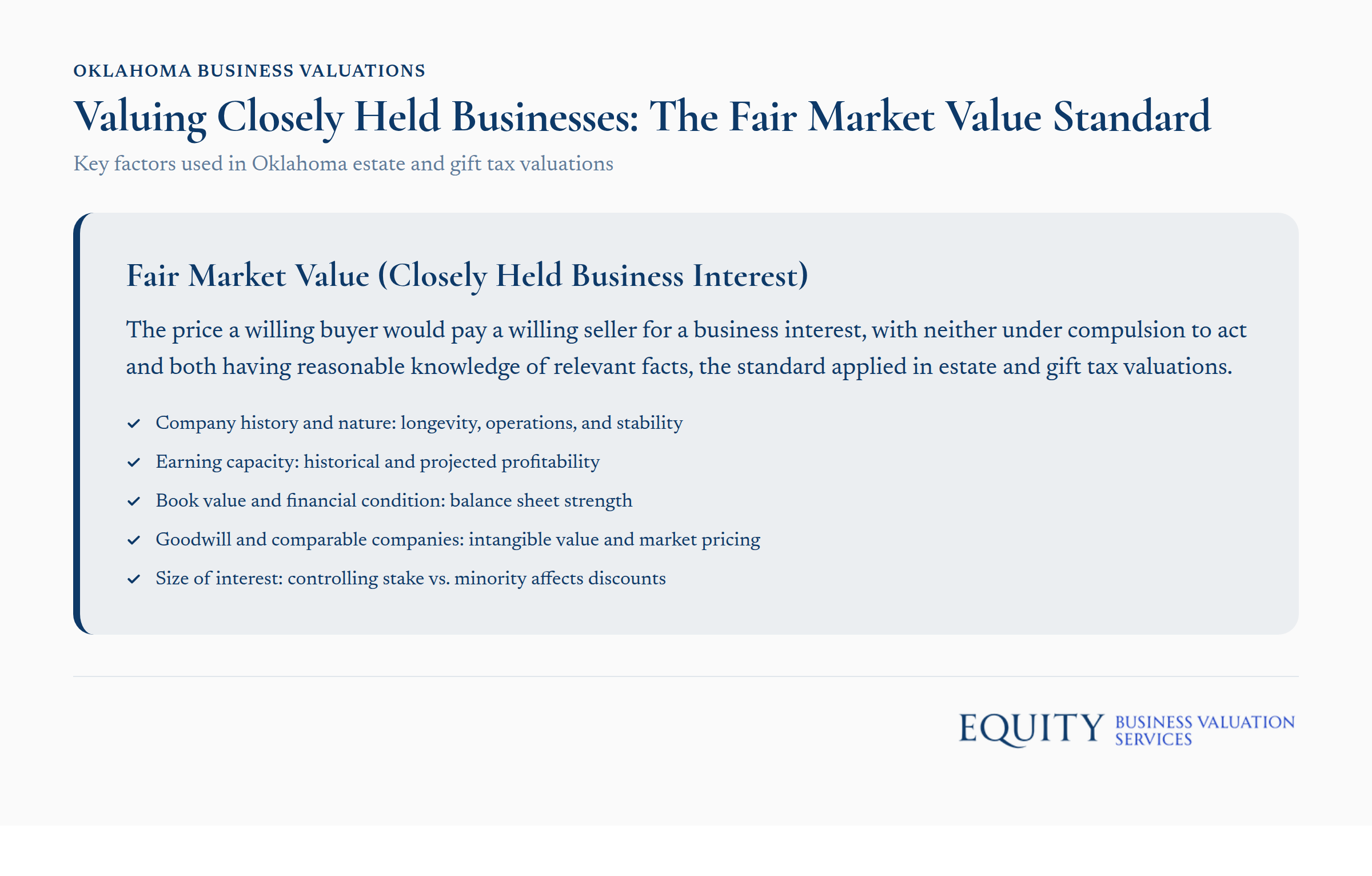
Fair market value, for federal estate and gift tax purposes, is the price a willing buyer would pay a willing seller, with neither party under compulsion to act and both having reasonable knowledge of the relevant facts. That is the standard used across estate, gift, and charitable contribution valuations, and it applies whether the asset is a piece of farm equipment or a controlling interest in an oilfield service company. For estate tax purposes, value is measured as of the date of death (or an alternate valuation date elected under federal rules); for gift tax purposes, it is measured as of the date the gift is made.
For closely held stock and business interests specifically, appraisers weigh a consistent set of factors: the company's history and nature of the business, its earning capacity and dividend-paying record, book value and financial condition, the presence of goodwill, and how the company compares to similar businesses whose stock is actively traded. No single factor controls. An oilfield service company with strong cash flow but thin book value gets weighed differently than a family farm holding significant land and equipment relative to modest annual income, even though both are closely held Oklahoma businesses subject to the same fair market value standard.
Common Factors in Closely Held Business Valuations
- Company history and nature of the business: how long it has operated, what it does, and how stable that operation has been.
- Earning capacity: historical and projected profitability, not just a single year's results.
- Book value and financial condition: the balance sheet strength behind the ownership interest.
- Goodwill: reputation, customer relationships, and intangible value beyond hard assets.
- Comparable companies: how similar businesses, especially those with actively traded stock, are priced in the market.
- Size of the interest being valued: whether the interest is a controlling stake or a minority position, which affects discounts.
Why a Qualified Appraisal Matters for Form 706 and Form 709
When a closely held business interest passes at death, it gets reported on Form 706, the federal estate tax return. When shares or membership units are gifted during life, often to reduce the size of a future taxable estate, the transfer is reported on Form 709, the federal gift tax return. In both cases, the IRS expects a valuation that stands on its own: a qualified appraisal prepared by a qualified appraiser, using recognized methodology, supported by the underlying financial data rather than a rough estimate from the owner or the family accountant.
This matters because closely held business interests are exactly the kind of asset the IRS scrutinizes most closely on audit. There is no public market price to fall back on, which means every assumption behind the number, comparable companies, discount rates, minority discounts, has to be documented and defensible. An appraisal prepared to a recognized professional standard gives the estate or the donor something to stand behind if the IRS asks questions later.
Key takeaway: the absence of an Oklahoma estate tax does not reduce the documentation bar. Federal review of a closely held business valuation is the same whether the owner lives in Oklahoma City, Tulsa, or anywhere else in the country.
Lifetime Gifting and the Adequate Disclosure Rule
Many Oklahoma business owners use lifetime gifts of company shares, often to children or to a trust, as a way to move future appreciation out of their taxable estate while the exemption is still historically high. That strategy only works cleanly if the gift starts the statute of limitations running. Under federal regulations governing adequate disclosure, a gift of a closely held business interest reported on Form 709 needs to include a description of the transferred property, the valuation method used, the financial and other data relied on, and any discounts claimed for lack of control or lack of marketability.
When that disclosure is complete, the IRS generally has three years from the filing date to challenge the reported value. When it is incomplete, or when the gift is valued informally without a real appraisal behind it, the statute of limitations never starts running, and the value stays open to challenge indefinitely. That is a significant risk for a family that gifted a piece of a growing agribusiness or manufacturing company a decade ago, only to have that valuation reopened after the business (and its value) has multiplied.
Watch Out
A gift of business shares that is valued informally, without a complete qualified appraisal describing the method and discounts applied, does not satisfy adequate disclosure. The clock on IRS challenge simply never starts.
What This Means for Oklahoma's Closely Held Businesses
Oklahoma's economy is built on a mix of industries where ownership is concentrated in a handful of hands: energy and oilfield services, production agriculture and family farms, manufacturing, and regional agribusiness. These are exactly the kinds of businesses that lack a public trading market and therefore need a real fair market value analysis rather than a back-of-envelope multiple. An energy services company with fluctuating annual revenue, a farm with significant land holdings but thin operating margins, and a manufacturing shop with strong but concentrated customer relationships each require a different weighting of the standard valuation factors, even though the underlying legal standard is identical.
For families doing succession planning, the valuation question usually shows up twice: once when shares are gifted during the owner's life to use exemption while it is available, and again, later, when the business (or what remains of the owner's interest in it) is valued as part of the estate. Getting the first valuation right, with full documentation, protects the second one from being reopened.
Getting a Defensible Valuation Before You File
Whether you are gifting shares now or planning for a future estate filing, the valuation needs to be built to survive review, not just produce a number for internal planning. Our team prepares USPAP-compliant business valuations for Oklahoma estate and gift tax purposes, using the fair market value standard and the closely held stock factors federal reviewers expect to see. Engagements are quoted as a fixed fee after we scope the assignment, based on the complexity of the entity, the completeness of its financial records, and whether the report needs to meet the qualified appraisal standard for an IRS filing. If you are weighing what that scope and cost might look like for your business, our pricing guidance walks through the variables that typically drive the fee.
If your family is also navigating a related estate settlement in probate court, our guide to how Oklahoma probate courts require business valuations covers the separate documentation those proceedings expect.
This article is provided for general informational purposes only and does not constitute legal, tax, or financial advice. Readers should consult a qualified attorney or CPA regarding their specific circumstances.